Work in Progress: The Voting Rights Act
Work in Progress is a recurring feature on CAMPAIGN TRAILS, in which I share some of the more interesting materials I’ve uncovered in my book-in-progress on the work of John Doar and the Civil Rights Division in the 1960s.
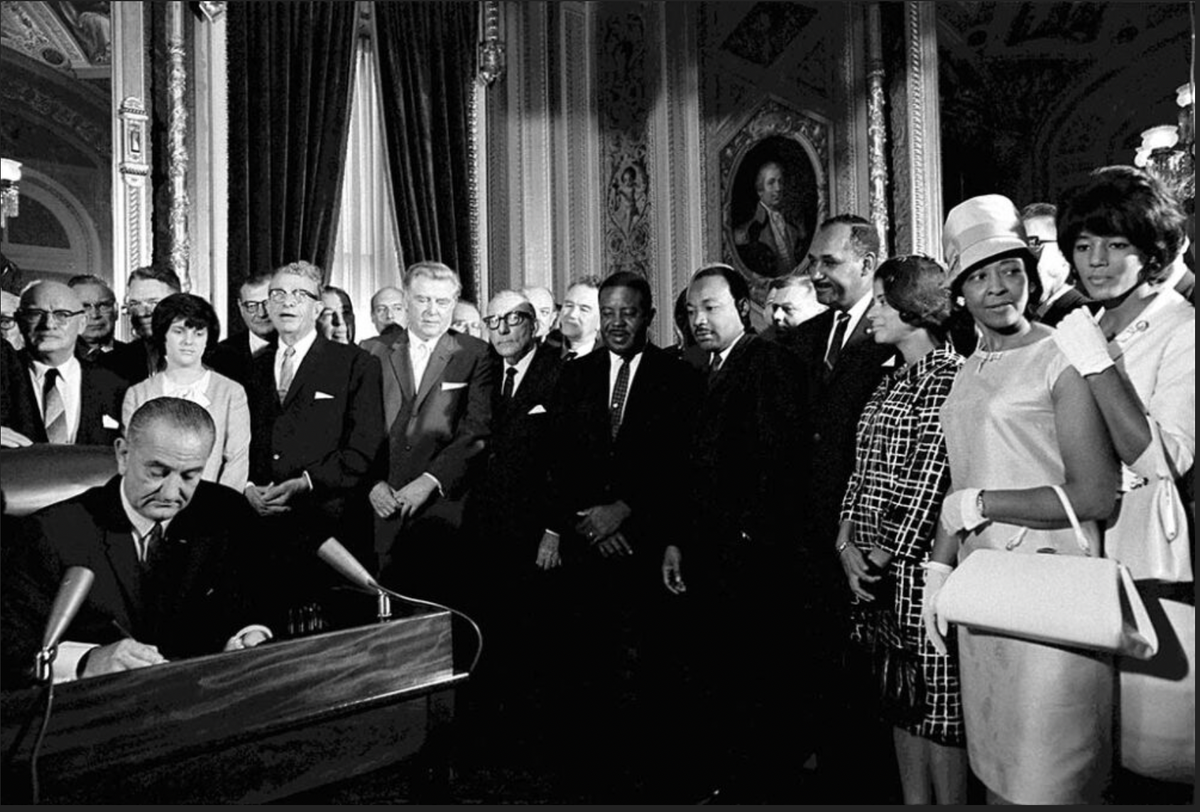
On this date in 1965, President Lyndon Johnson signed the Voting Rights Act into law.
While there's been a great deal of attention on the voting rights campaigns in Selma and other southern locales that made the VRA possible and a good deal of work on the legislative fight to make the VRA a reality, the actual rollout of the law – the hard trench work that transformed the promises written on paper into a tangible reality on the ground across the South – has largely been overlooked.
One of the things I'm seeking to do in my forthcoming book on John Doar and the Civil Rights Division is to explain what actually unfolded there. Here's a small sample:
On Thursday, August 5, 1965, John Doar sent his lawyers a letter detailing everything they had to do in the days to come. “The Voting Rights bill will be signed Friday at noon,” he began. As soon as that happened, the pre-arranged correspondence between the attorney general and census director “must be back and forth Friday afternoon, so that they can be published in the Federal Register Friday night.” Moreover, their lawsuit against the poll tax – which they had promised to file to secure the final votes in Congress – “must be on a plane for Mississippi Friday night.” The form letters they prepared for county registrars had to be in Saturday’s mail, too. Then, the key: “Justification memos for the designation of examiners in particular counties must be prepared for the Attorney General by Sunday night,” he instructed. “These justification memos are very, very important and must be done with the utmost care by the lawyers and with the most up-to-date information.” Then, on Tuesday morning, little more than a day after the counties were chosen, federal examiners would begin their work in the South with “teams of lawyers” supporting them.[1]
The next day went according to plan. Shortly after noon, Lyndon B. Johnson delivered a speech to dignitaries gathered in the Capitol Rotunda and millions more watching at home. As with every other part of the process, lawyers from the Division had reviewed the text and given their approval.[2] “This act flows from a clear and simple wrong,” the president said plainly. “Its only purpose is to right that wrong. Millions of Americans are denied the right to vote because of their color. This law will ensure them the right to vote.” The president thanked those who had worked on the bill, but focused more on the officials who would carry the cause forward. He listed the steps the Department of Justice would take that same day, filing the poll tax lawsuit and adding the law to the Federal Register. He instructed them “to work all through this weekend” to decide which counties would be in the first wave of implementation, promising that “by Tuesday morning, trained Federal examiners will be at work registering eligible men and women in 10 to 15 counties.”[3] Afterwards, Johnson retreated to the President’s Room off the Senate chamber, where Lincoln had signed the order freeing the first slaves of the Confederacy, on that same date, more than a century before.[4]
As Johnson carefully added his signature, using a series of ceremonial fountain pens, a beaming crowd of politicians and civil rights leaders looked on. Surprisingly, even though the Selma campaign had been closely associated with the legislation, only a few veterans of that fight were on hand, such as Martin Luther King Jr. and John Lewis. Most of the guests hadn’t been involved in the struggle for voting rights at all. Instead, they were known for other milestones in civil rights. White House staffers had invited James Meredith (“the first Negro to graduate from the University of Mississippi”), Vivian Malone (“the first Negro to graduate from the University of Alabama” who was “a charming, pretty girl”), and Rosa Parks (“the woman who started it all” with the Montgomery bus boycott).[5] As the president entertained his guests, reporters gravitated to John Doar, looking for insight on what came next. The assistant attorney general stressed that they expected most localities to comply with the law and would therefore send federal examiners out sparingly. Their lawyers had conducted a thorough review of the region, Doar noted, but the attorney general had not yet made his final determinations.[6]
Lawyers in the Division had been preparing for this moment for years. The skills honed waging voting discrimination suits for a half-decade, the command developed of specific details and larger narratives, the experience telling those stories to audiences who desperately needed to hear them, all came to bear in the “justification memoranda” they crafted that weekend. On the surface, these memos were simply more government paperwork mandated by law. But in a deeper sense they justified the Civil Rights Division’s entire mission. Like the closing arguments they had practiced and perfected in hostile courtrooms across the South, the memos laid bare the stark inequalities of Jim Crow democracy and made a persuasive case for intervention.
Just as he had for their trial work, John Doar laid out clearly his expectations for how his lawyers should craft these memos. First, attorneys had to justify intervention to themselves. “Begin with a careful evaluation of the facts and a lawyer-like evaluation based on the statutory criteria,” he instructed. They could move on their own initiative, but also needed to be ready to respond to petitions from the public. “When complaints are of sufficient number and nature in a county to raise substantial doubts about compliance with the Act,” he told them, “we must determine if they are meritorious.” If an FBI investigation were needed, it should be “initiated quickly” within 24 hours. If that inquiry then confirmed complaints, the lawyer should notify Doar so they could formulate a reply. “In all probability,” he explained, “contact will be made with the local registrar in an effort to persuade him to improve.” If that failed, then a case for intervening would be made.[7]
That case, Doar explained, had to be made plainly and dispassionately. “Care should be exercised throughout the justification memorandum to make no flat statements which have not been established either by a court finding or by the filing of a civil or criminal complaint,” he noted. “Open investigations should only be referred to as such. Unproven allegations of intimidation, for instance, should not be included. The tone of the memorandum should be factual—use nouns and verbs, no adjectives.” As head of the Division, Doar would review their work and, assuming he agreed, send their recommendations to the attorney general. If he agreed to appoint federal examiners to a county, section chiefs in the Division then bore responsibility for instructing the Civil Service Commission to dispatch its officials and informing relevant FBI officials as well. They would then assign Division attorneys to assist the process, to keep Doar updated and to decide “as soon as possible” when the FBI observers could be sent away. [8]
The justification memo for Dallas County, for instance, came as a four-page letter from Assistant Attorney General John Doar to his superior Attorney General Nicholas Katzenbach. “I recommend that a Federal Examiner be appointed under the 1965 Voting Rights Act to receive and process applications from citizens of Dallas County, Alabama,” it began. The memo ticked off three reasons – the low registration rates of African Americans, the county’s “history of discrimination against Negroes” in elections, and the repeated failure of local officials to comply with the law. A quick presentation of statistics proved the first point, while the findings of federal courts backed up the second. The stubborn resistance of Selma’s white officials received the most attention, but even that saga was recapped in little more than a page. Short and effective, the memorandum reflected Doar’s preference for “facts, facts, facts” that led the reader to an inescapable conclusion.[9]
Even when justification memos made a strong case for intervention, Katzenbach gave voluntary compliance one last chance. The president had promised the first counties would be revealed Monday morning, but the attorney general spent most of that day talking with officials across the South. Finally, at 5:30pm, he announced there would be federal examiners in nine counties – Dallas plus three more in Alabama, three in Louisiana, and two in Mississippi.[10]As the Baltimore Sun noted, each was a “hard-core” county with a real record of discrimination.[11] In every one, 65 to 100 percent of whites were registered, compared to under 10 percent of blacks.[12] As soon as Katzenbach made his decision, John Macy of Civil Service announced that he was dispatching federal examiners to each immediately. The next morning, they would start registering voters.[13]
[1] John Doar to Mr. Pollak et al., 5 August 1965, Box 102, JD.
[2] Alan Marer to John Doar, Routing Slip, 5 August 1965, Box 35, JD.
[3] Lyndon B. Johnson, Remarks in the Capitol Rotunda at the Signing of the Voting Rights Act, 6 August 1965 (https://www.lbjlibrary.org/object/text/remarks-capitol-rotunda-signing-voting-rights-act-08-06-1965)
[4] New York Times, 7 August 1965, 1; Los Angeles Times, 6 August 1965, 2; Atlanta Constitution, 7 August 1965, 1.
[5] Joe Califano, Memorandum for the President, 5 August 1965, HU 2-7, Box 55, LBJ-WHCF.
[6] LAT, 6 August 1965, 2.
[7] John Doar to Section Chiefs, “Procedures for the Continuing Evaluation of Counties Covered by 4(b) of the 1965 Voting Rights Act,” 24 August 1965, Box 35, JD.
[8] Idem.
[9] John Doar to Nicholas deB. Katzenbach, Appointment of a Federal Examiner under the 1965 Voting Rights Act for Dallas County, Alabama, [August 1965], Box 234, JD.
[10] AC, 10 August 1965, 1.
[11] BS, 10 August 1965, 1.
[12] John Doar, Memorandum for the Attorney General, 22 July 1965, Box 234, JD.
[13] CT, 10 August 1965, 1.