Pulling Up the Ladder
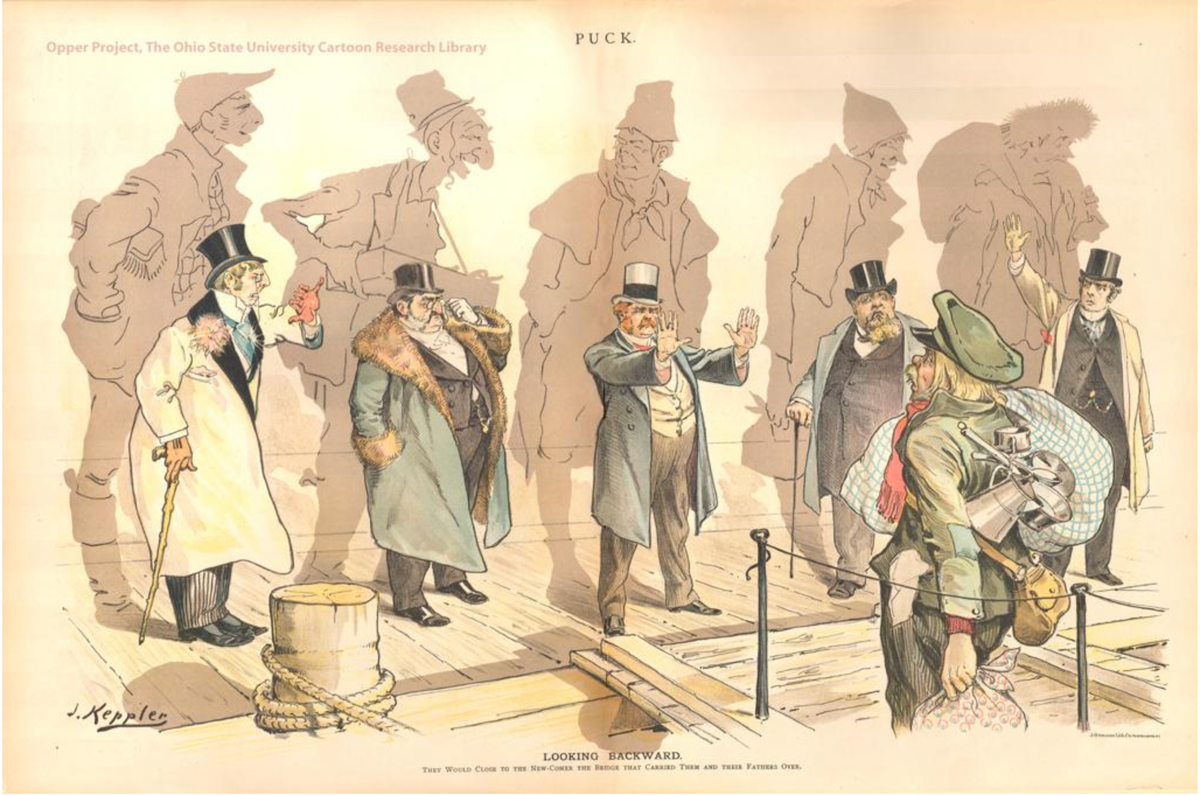
In recent weeks, Republican representatives in Congress have repeatedly insisted that specific groups of immigrants in their communities will never be assimilated into American life, that they pose a serious danger to their neighbors, and therefore that they should be forcefully removed from the United States.
On Monday, for instance, Rep. Michael Rulli (R-OH) went on Fox News to applaud reports that ICE was preparing a large-scale operation to deport Haitians from the state of Ohio, even ones who played by the rules to get here. "Let's get them out of here," he said. "Let's get 'em all out of here, and let's start from the beginning."
And on Wednesday, Rep. Tom Emmer (R-MN), took time to tell something called Alpha News that he still backs a similar effort to remove the Somali immigrants from the state of Minnesota. "We are not creating a new Somalia," he said. "If you do not want to be an American, you do not want to assimilate, then get the hell out of here. Go back to where you came from. You don't belong here."
Such statements about the supposed inability of non-white immigrants to become "real" Americans are, of course, deeply racist. But they're also easily refuted.
Indeed, all we have to do is look at the congressmen themselves.
I'm not a genealogist by any means, but Rulli is an Italian surname and Emmer a German one. I am a historian, so I can tell you that the exact same kind of nativist nonsense was spewed by earlier generations of Americans towards people who had last names like Emmer and Rulli.
Indeed, as Erika Lee noted in her brilliant chapter on immigration panics in Myth America, German-Americans were actually the first group of immigrants who sparked a serious panic in the Anglo-American colonies and early United States.
Ben Franklin, for instance, worried constantly about the German menace. In 1750, he wondered “Why should Pennsylvania, founded by the English, become a Colony of Aliens, who will shortly be so numerous as to Germanize us instead of our Anglifying them, and will never adopt our Language or Customs, any more than they can acquire our Complexion.”
(And yes, remember this is an era when people we now classify as a homogenous "white" pretended they could discern differences in skin color between English and Germans.)
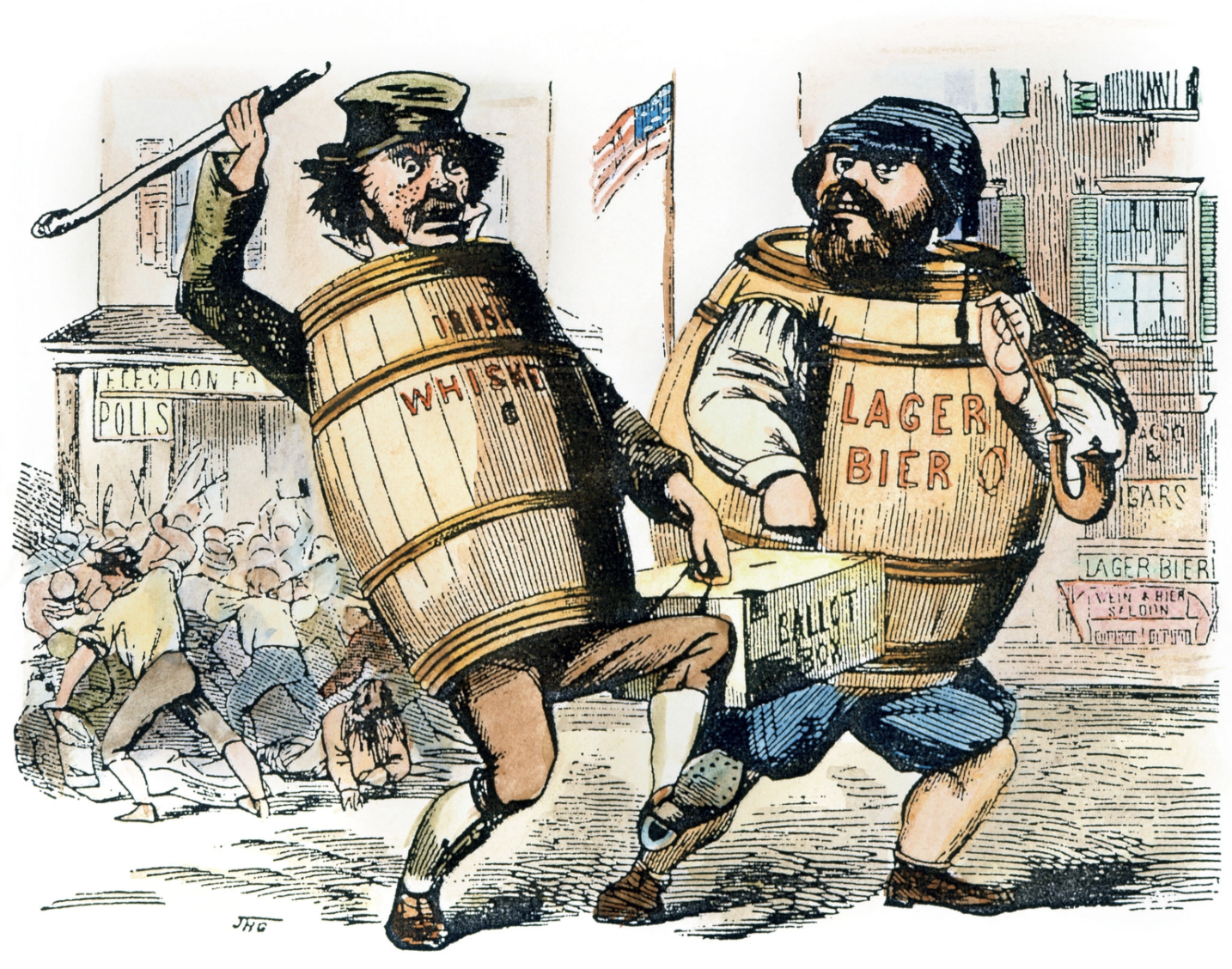
Though it didn't get as much attention as the more prominent anti-Irish hatred of the mid-nineteenth century, the anti-German bigotry often went hand in hand with it. The so-called "Native American Party" or "American Party" – more commonly known as the "Know-Nothing Party" after their code of secrecy – targeted Irish and German immigrants in kind, as mindless drunks who could be easily manipulated at the ballot boxes to produce election fraud.
Even as German-Americans steadily assimilated, there were moments when the old anti-German bigotry could come flaring back. World War I, of course, was such a moment.
Official propaganda attacked the war-mongering "Huns" of Germany and used a variety of dehumanizing images – apes, ogres, monsters, etc. – to make the enemy seem as monstrous as humanly possible.
And, as often happens, the invective directed abroad had nativist echoes at home, with a surge of attacks on German-Americans here. Their patriotism and their loyalty were questioned once again, and as an added insult, nativists worked to erase their influence wherever possible. Speaking German was outlawed in some states and teaching it strictly forbidden as well. The knee-jerk reaction was so strong that Americans renamed sauerkraut as "liberty cabbage" and hamburgers as "liberty steaks" to avoid the German taint.
And yet, despite all this hostility directed against German-Americans – across one world war and then another, when Germans were literally killing Americans – the German-American population continued to thrive, to the point where a man with the surname "Emmer" could be elected as a congressman.
The same pattern holds true with Rep. Rulli and Italian-Americans.
The waves of Italian immigration came later than the German ones, but that only meant they were met with even greater racism and resistance from nativist forces. While Germans were grudgingly acknowledged to be industrious (when sober), the Italians were universally regarded as criminals, as an inferior race who all belonged to the mafia.
Here's a good illustration:
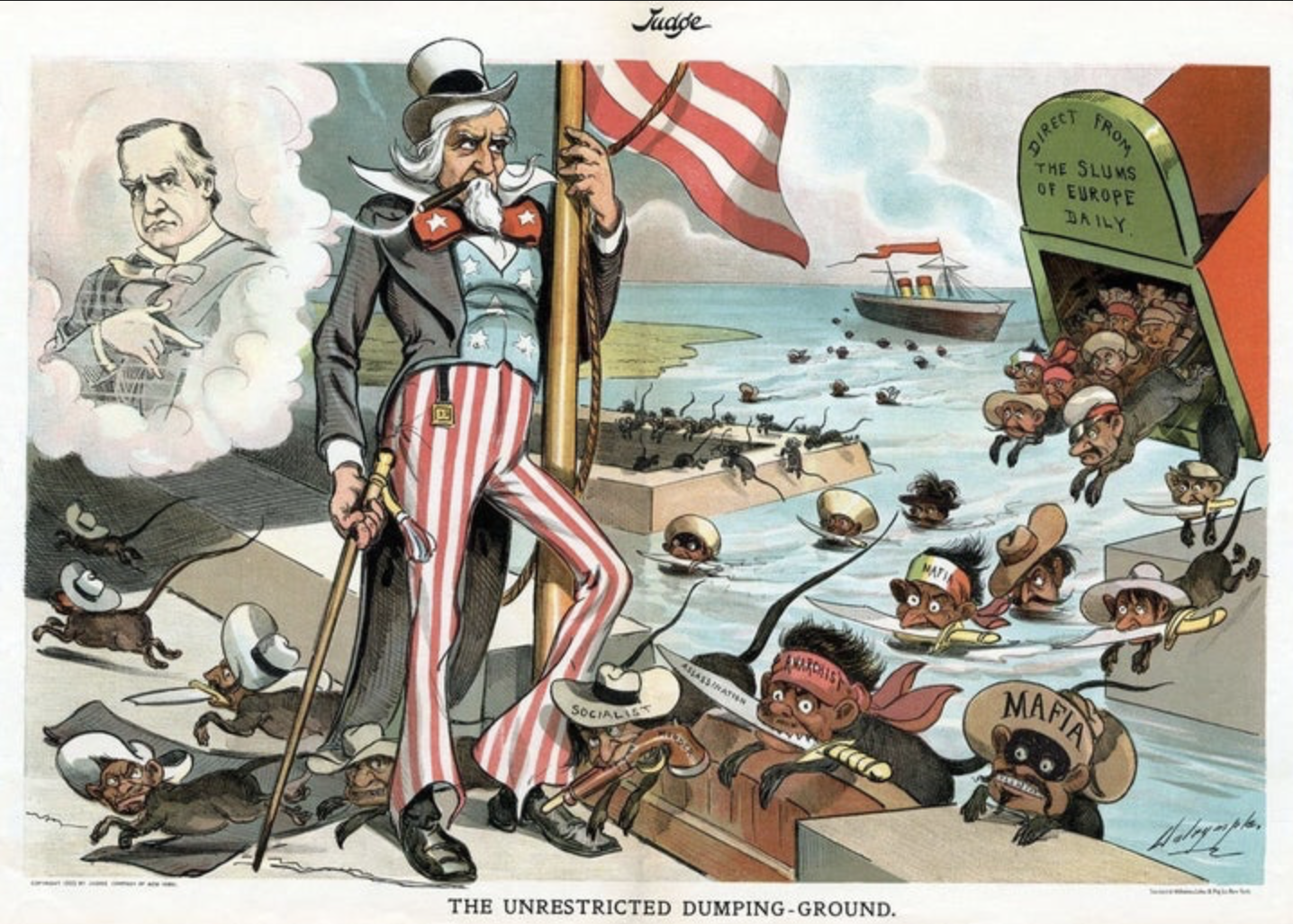
Check out the lower left corner in a close-up. Those dark-skinned mustached figures who look like the racist Speedy Gonzales caricature of Mexican Americans are, in fact, meant to be Italian immigrants. And look at their hats: SOCIALIST. ANARCHIST. MAFIA. They're carrying guns and knives, one even labeled "ASSASSINATION" in case the intent was unclear.
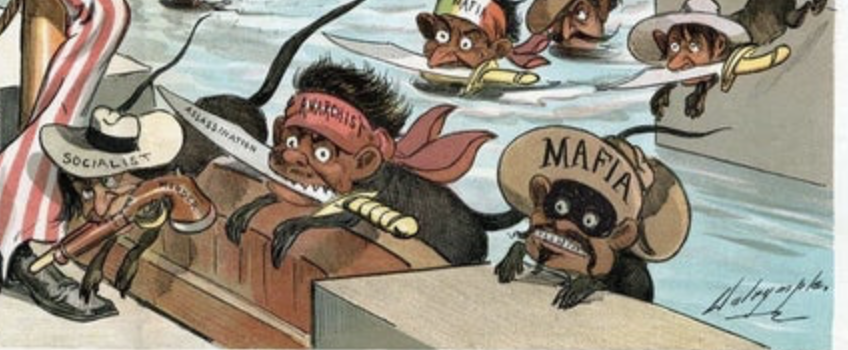
The Italian immigrants weren't just regarded as a shiftless race of bloodthirsty criminals; they were also a menace because they adhered to a "foreign religion." They were Catholics, beholden to a foreign power – the pope in Rome – and therefore doubly suspect in their abilities to become truly American.
We often forget that Italian-Americans were frequent targets of white supremacist organizations and isolated acts of violence throughout the late nineteenth and early twentieth century. In 1891, the mayor of New Orleans blamed "Sicilian gangsters" for the murder of the police chief. Over a hundred Italians were jailed and, when they were found innocent, a mob stormed the jail and lynched nearly a dozen of them. And in the 1920s, with the heyday of the second Ku Klux Klan, Italian-Americans again became a convenient target for white Protestants who wanted to stand against the religious and racial threat in their midst.
But again – luckily for Rep. Rulli – the argument that Italian-Americans could never assimilate, that they had to be rounded up and deported for the safety of the larger community, was slowly overcome. And once again, the very people who were targeted by nativists in one generation would produce a new kind of nativist in another.
I say all this not to try and shame Rep. Rulli and Rep. Emmer or to change their minds. They've clearly bought in completely to the racist ravings of their cult leader. Instead, I'm writing this to point out to everyone else just how obviously wrong their argument is.
The very existence of Rep. Rulli and Rep. Emmer – as Italian-American and German-American members of Congress – proves that the arguments of nativists are bankrupt to the core. Early generations said that Germans could never become truly American, that Italians could never be assimilated to "our" ways. But these two descendants of immigrants have proven that they can become so thoroughly American that they'll adopt the same vile language that was directed against their own ancestors and claim it as their own.
What's more American than that?