Denouncing Extremists
One of the media's favorite activities is demanding that Democratic politicians denounce individuals on their side who have made extreme statements.
This is a pattern that stretches back to the 1992 presidential campaign, when Democratic presidential Bill Clinton denounced Sistah Souljah – a minor rapper who had made extremist comments in the wake of the LA riots – as a way of signaling he was a different kind of Democrat. More moderate, more electable.
The Beltway press seems to have internalized that moment as a rite of passage for all Democratic candidates, something they all must do to the satisfaction of the press to signal that they, too, are someone that the mythical middle-class moderate median voter of their imagination will think that this Democrat isn't like the others. This Democrat is electable.
We saw this on full display during the 2008 campaign, when Barack Obama – a Democrat who was even scarier for reasons the media could not discuss in polite company – was forced to denounce anyone on in his orbit who had done anything remotely intemperate.
The press made a massive deal about Obama's former pastor Reverend Jeremiah Wright, demanding the candidate denounce him for once saying "God damn America." The drumbeat grew so steady, threatening to drown out actually important issues in that important campaign, that Obama finally made a major address in which he denounced the minister once and for all.
But Reverend Wright was only the most famous figure the media demanded Obama denounce. It turned out that Bill Ayers, who had gained notoriety as part of the 1960s radical organization the Weathermen, had hosted a fundraiser for Obama's first run for the Illinois state senate more than two decades earlier.
Even as the financial meltdown was consuming the country, elements of the news media devoted their time – and demanded the campaign devote its time – to a deep discussion of what turned out to be a non-existent relationship. The Wall Street Journal tried to find something there, of course, but so did The New York Times. CNN breathlessly reported that the two men had served on some of the same non-profit boards in the city of Chicago. NPR gave it a full hearing too.
Contrast that full-press assault from the press – demanding that a Democratic presidential candidate answer for the opinions of a former minister and someone who could at best be called a casual acquaintance – with the relative silence when it comes to Republicans and Elon Musk.
Elon Musk is probably the most influential and important person in the Republican Party today, after President Trump and his sidekick Chief Justice Roberts.
First and foremost, Musk is footing the bill. The billionaire has been the biggest financial donor to the GOP in recent cycles, most notably with the $277 million he spent on his political action committee that backed Donald Trump and other Republican candidates in the 2024 campaign. But even beyond that record-setting sum, Musk spent millions more on other Republican campaigns and causes, such as $50 million for an anti-trans organization called Citizens for Sanity.
Second and almost as important, Musk used his fortune to purchase Twitter and to warp it into a public forum where conservative ideas get more attention and where Republican politicians have a leg up. Studies have shown that Musk tweaked the algorithm there to give Trump and others a boost, an incredibly important form of donation-in-kind that made him an even more important part of their politics.
And after the 2024 election, Musk's influence in Republican circles only continued to grow. During the presidential transition period, Musk was a constant present at Trump's Mar-A-Lago, so much that The Washington Post noted the "Musk has emerged somewhere between unofficial co-president and 'first buddy.'" ("First Buddy" was, of course, Musk's own dorky designation.) When his outsized influence pushed Republicans to embrace a government shutdown, media outlets even started calling him "President Musk" or "the shadow president."
In the early days of the second Trump administration, Musk's dominant role in the administration was formalized with the creation of his Department of Government Efficiency. Musk was received in the White House and, as payback for his ample money and mouth, given unprecedented power. He and his army of twenty-something tech-bros were given free rein to ransack the government and ruin much of its operations, all under the pretense of "cutting waste" and "promoting efficiency." While the rest of the nation and, indeed, the world has suffered from these cuts, Elon Musk has done just fine.
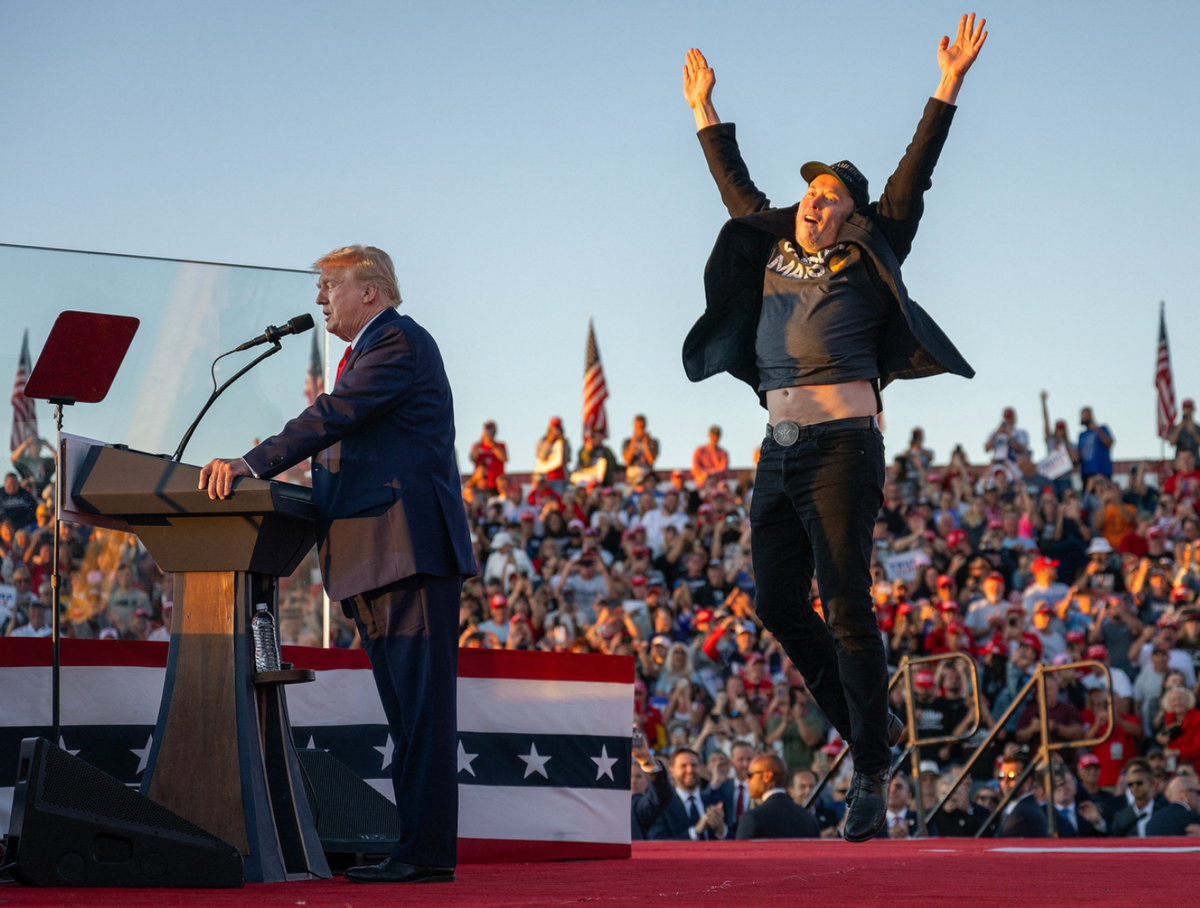
There's no denying that Elon Musk is one of the most influential figures in the Republican Party today. He's by far their biggest funder. He's campaigned for them, from massive rallies for the president in 2024 to even trying to bribe voters with million-dollar checks in the Wisconsin state Supreme Court races in 2025. He's already poured another $71 million into Republican races for the midterms, but there will surely be more down the stretch.
The level of financial, media and political support that Elon Musk has given to the Republicans means that he is truly a central, driving figure in Republican Party politics.
And if the media could get itself worked into a frenzy over marginal figures in Obama's past – again, a former pastor and a casual acquaintance who hosted one (1) fundraiser for a state senate campaign two decades earlier – then it seems like we should expect them to be absolutely howling at the top of their lungs that the megalomaniac tech billionaire who is currently, right now, at this very moment the driving force dictating the politics of the president and the party he leads.
And there's a lot Republicans need to answer for.
The top donor to the Republican Party is obsessed with race. I mean, it's a lot. No, really.
The top donor to the Republican Party is an ardent proponent of racial pseudo-science, amplifying discredited and disreputable theories about the superiority of the white race and the inferiority of others.
The top donor to the Republican Party has shared and endorsed posts on social media calling for "white solidarity" in America and urging "remigration" of those immigrants he apparently deems racially incompatible with the country he chose to immigrate to himself.
The top donor to the Republican Party is a promoter of the so-called Great Replacement Theory, the racist conspiracy theory that has sparked several mass shootings, including recent tragedies in America.
While the media has done excellent work chronicling all of Musk's donations and directions, they haven't remotely made this as big of an issue as it should be. They've spent recent weeks demanding that Democrats denounce the Twitch streamer Hasan Piker – even when those Democrats had no relationship with him at all! – but barely a question to Republicans who are receiving massive amounts of money and even more free publicity from their top donor Elon Musk.
I'm not sure why.
Maybe it's because they're in the tank for Republicans.
Maybe it's because they're still on Twitter themselves and asking Republicans about their ties to Musk would make them feel uncomfortable about their own ties to him.
But I am sure it's got to end. The media clearly won't do it themselves, so Democrats need to make this an issue in the campaign, denouncing Musk's ongoing extremism in no uncertain terms and forcing this into the conversation.