Operation: Albatross
As the midterm elections draw near, it seems ever likelier that we're finally going to witness a reckoning for Republicans.
For nearly two years now, Republican members of the House and Senate have tied themselves as closely as humanly possible to President Trump. Whether they were shrewdly riding his coattails or cowardly hoping to avoid his wrath, congressional Republicans have been goose-stepping in formation with Trump for most of this second term. No matter how dumb or destructive his ideas have been, they have supported him time and time again, casting their votes for some of his ideas but more important casting away their independence and authority and oversight to let him run wild on his own.
But it turns out that letting a deeply-stupid and incredibly self-centered leader like Donald Trump get his way on everything is not, in fact, a good idea. Over the past year, Republicans got to watch as their cult leader screwed up everything from a trade war to a real war.
To make matters worse for them, the president seemed blithely unconcerned with the widening costs of his growing list of fuckups, shrugging off soaring prices for groceries and gasoline, and much much more. Instead, he focused his attention more and more on giving himself an obscenely ostentatious ballroom, on transforming the White House into a tacky Trump casino, and on plastering his name on as many prominent public buildings as humanly possible.
Not surprisingly, as the president ignored the problems he caused for Americans and focused on the prizes he would personally take from them, his approval rating has steadily gotten worse and worse. He's now averaging in the mid-30s, with some individual polls coming close to crossing into the 20s.
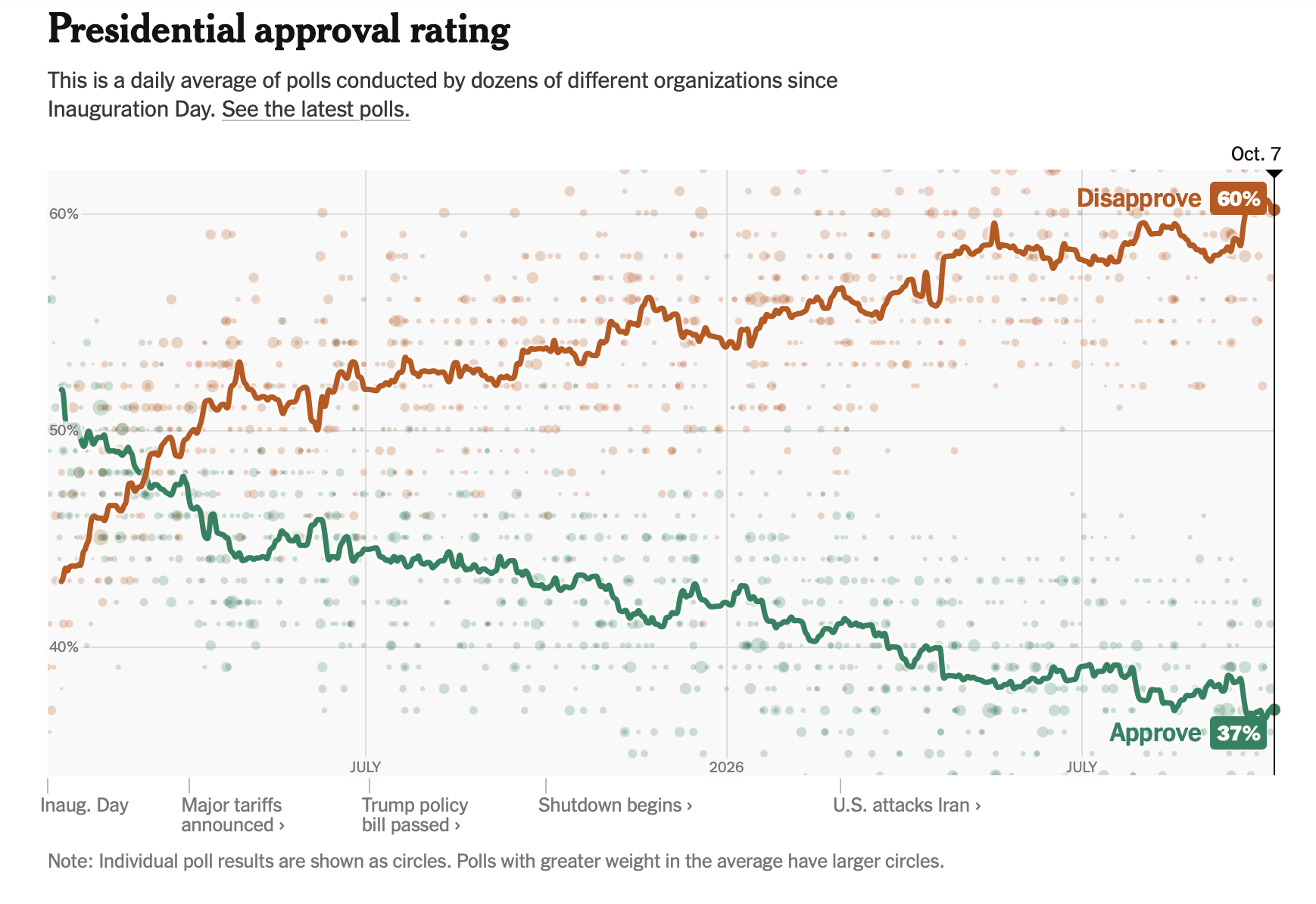
To put this in comparison, at this point in 2006, George W. Bush was standing in roughly the same spot, at 37% approval in the Gallup Poll. At this point in 2010, Barack Obama was at 46%.
Those presidents, however, had the political sense to understand that they were not as popular as they had been two years before when they were on the ballot themselves and therefore allowed the embattled members of their parties to put a little nominal distance between themselves and the president.
News coverage at this point in the 2006 cycles was filled with headlines like "GOP Candidates Stress Independence From Bush" or "Republican Ads Show Distance from Bush." Four years later, we saw a similar pattern: "Incumbent Dems Distance Themselves from Obama" and "Obama Missing from Democrats' Campaign Ads."
Even with that kind of damage control, in both elections it simply proved impossible for the president's allies in Congress to escape being dragged down by the president's unpopularity with voters. In 2006, Republicans lost 31 seats in the House and 6 in the Senate, losing control of both chambers. In 2010, Democrats lost 63 seats in the House and 6 in the Senate, losing control of the House but barely hanging onto the Senate.
By comparison, Trump has placed his loyal lickspittles in Congress in an even tougher bind.
For starters, he's less popular than Obama was in 2010 and somehow even less popular than Bush was in 2006, but unlike those two presidents, he seems to be incapable of acknowledging that obvious fact. Throughout the past year, as his approval rating has dipped lower and lower and lower, the president has insisted – over and over and over – that these polls are all "fake news" and that he is actually quite popular.
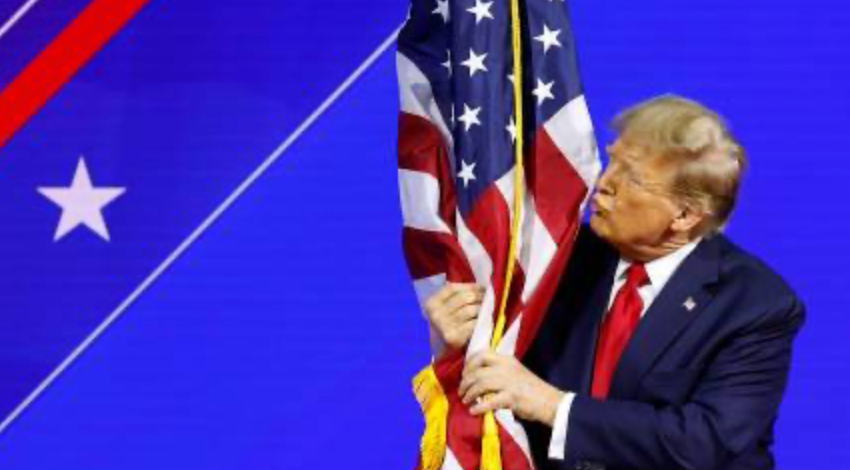
And precisely because he's in denial about how deeply unpopular he really is, Trump has decided that what congressional Republicans really need isn't a little distance from him and a little plausible deniability about their role in enabling the current shitstorm that is American life. He's decided that the answer to their problems is the same answer he offers for every problem: More Trump.
Rather than letting individual Republicans look out for their own self-interest by cutting their ties to the unpopular president and presenting themselves more as independent-minded officials attuned to the needs of their communities and constituencies, Trump forced the entire Republican Party to rally around him.
Always hungry for the cameras, he made sure that the real start of the midterm campaigns after Labor Day stressed his own centrality to the Republican Party.
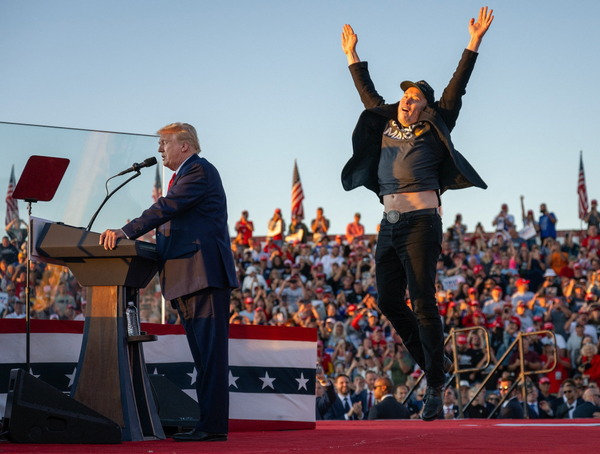
The president had his party throw an ill-advised "midterm convention" in Dallas, where he made it perfectly clear that the midterm elections were, in fact, all about him. “You’ve got to do me a favor,” he told the crowd there. “You’ve got to get out and vote, and you’re going to pretend I’m on the ballot. Because in a way, I’m on the ballot.”
But as Republicans quickly learned, drawing more attention to the deeply-unpopular president just made him more unpopular, and them too by extension.
Ken Paxton, who ousted incumbent senator John Cornyn in the primary thanks to Trump's help, was soon privately grumbling that Trump's "help" was now hurting him and his campaign. In a since-leaked audio recording, the candidate was asked about Trump: “Do you feel like he’s a little bit of a drag?” Paxton agreed that he was. “To be honest with you, the numbers — when we did that convention — it dropped our numbers. Everybody’s numbers dropped. Right now, yeah, not good.”
Refusing to accept reality, President Trump is still insisting that he is incredibly popular. In a recent interview with Time magazine, when he was told his poll numbers "have never been lower," the president responded with a typical tantrum. "They're fake numbers," Trump responded. "I would beat anybody running today by 20 points. Your numbers that you have are fake. The pollsters are corrupt. They're almost as corrupt as the writers."
And refusing to accept that he is therefore a drag on Republican congressional campaigns, Trump has committed himself to spending the final 32 days before the midterms on the road, campaigning for GOP candidates whether they want his help or not.
But this whirlwind tour of the nation is only underscoring just how bad things have gotten for Republicans. The map of Trump's recent and upcoming appearances runs not through typical battleground districts and states, but through deep red regions where Republicans would typically be quite confident of their chances in the fall – Iowa, Florida, Texas, Oklahoma, even Alaska. His mere presence in these places shows just how desperate things have become.
And worse for the White House, the candidates running in these red regions are clearly doing everything they can to distance themselves from the president. We saw this last night when Maine Senator Susan Collins repeatedly refused to say whether or not she would share a stage with the president if he came to campaign for her. And we're seeing it in Texas where Governor Gregg Abbott – suddenly in a tight fight for his own re-election – has announced he won't be attending the president's upcoming rally in San Antonio. A similar pattern is playing out all over the country as Republicans everywhere are trying to run away from Trump.
The problem for them is that Trump keeps running after them.
In a piece just published today, Aaron Blake at CNN gave a good summary of the bind Republicans are in:
Trump increasingly appears rather sensitive about this dynamic — which makes sense, given he’s latched onto the theory that he alone can push his party to victory in less than four weeks, despite his low approval numbers.
He went on a tear about his rallies on Tuesday, bringing it up at least five separate times.
“By the way, I’m going around doing rallies. The Republican Party is starting to go right through the roof,” he said at a non-campaign event in Baltimore. “Somebody said today, ‘I wonder why?’ Well, I started — I had to get out. I had to do it.”
....
He posted on social media that his “Rally crowds and enthusiasm are unbelievable!” He added: “We are flipping races all over the place. … It’s all happening!”
In a separate post, he said simply: “MY RALLIES ARE SAVING THE REPUBLICAN PARTY, AGAIN!!!”
The president understands himself, as always, as the center of attention. He has decided that the best course for the Republican Party is to lash himself as tightly as possible to the other candidates and the other candidates to him, to remove any sense of distance or difference between them, in order to make sure that voters come to feel the exact same way about them as they do about him.
Democrats can only hope the president's plan succeeds.