Honor America Day
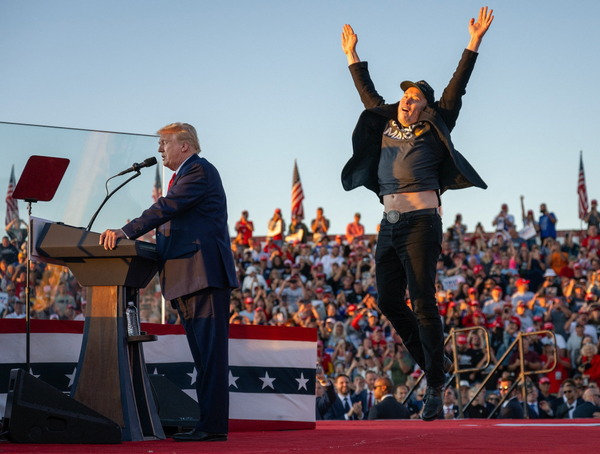
President Donald Trump, the nation's vandal-in-chief, has made an absolute mess of Washington over the past year. The botched renovation of the Reflecting Pool is merely his latest and least accomplishment in a long string of defiling and defacing the District of Columbia.
But coupled with the president's sweaty efforts to harness the coming celebrations on the Fourth of July to deflect from his failed war abroad, the Reflecting Pool drama has some sharp echoes of something that Richard Nixon tried for the Fourth of July back in 1970.
As I noted in One Nation Under God, the revelations that spring that President Nixon had widened the war in Vietnam with the deployment of ground troops in Cambodia sparked massive public backlash and protests across college campuses, including the ones that led to student deaths at Kent State and Jackson State.
Panicking, the Nixon administration enlisted its high-powered supporters to put on a massive celebration for the Fourth of July, called "Honor America Day."
Here's the story:
At a press conference on June 4, 1970, Billy Graham unveiled plans for the “pro-America rally” he had earlier proposed for the Fourth of July. With comedian Bob Hope at his side, the minister told reporters that “Honor America Day” would be “the biggest celebration in America’s history.” The day-long event would take place at the capital’s major monuments, with Graham leading a religious service at the Lincoln Memorial in the morning and Hope emceeing an all-star program of music and comedy from the Washington Monument in the evening. The entire extravaganza, Hope said, would show the world that “Americans can put aside their honest differences and rally around the flag to show national unity.”[1]
Though organizers insisted the event was for all Americans, the program had been carefully designed to appeal to the Silent Majority. Dwight Chapin, who had followed Haldeman from J. Walter Thompson to the White House, explained the early plans in a memo to his boss. “All this is excellent!” an enthusiastic Haldeman wrote in the margins, but “we need a solid cornball program developer.” Accordingly, they enlisted J. Willard Marriott to bring the same sort of old-fashioned entertainment that he had provided for the inauguration a year before. He soon announced commitments from mainstream performers including comedians Jack Benny and Red Skelton and musicians Glen Campbell, Connie Stevens and Dinah Shore. Kate Smith would perform her rendition of “God Bless America,” a song she had been performing for nearly a quarter century, while a recent runner-up in the Miss Teen America pageant would recite an original composition titled “I Am An American.” (When radicals mocked the lineup as “a program for fossils and dinosaurs,” Marriott made a show of searching for hipper acts like the comedian Dick Gregory and the folk trio Peter, Paul and Mary. But all of them, he reported, had prior commitments.)[2]
Funding for Honor America Day followed the same general pattern. Publicly, organizers remained coy. Asked by reporters how it would be financed, Hope asked, “Do you have any ideas? So far we’re using a pay phone.” Out of sight, though, Marriott had it well in hand. A seasoned Republican fundraiser, he quickly secured over $285,000 in donations, largely from corporate leaders. Some were philanthropists who had supported similar celebrations in the past, most notably J. Howard Pew, who had bankrolled Spiritual Mobilization’s Fourth of July celebrations in the early 1950s, and Patrick Frawley, who funded Fred Schwarz’s Christian Anti-Communism Crusade programs in the early 1960s. They were joined by corporations that had often donated to those same earlier endeavors: General Motors, Caterpillar Tractor, Marshall Field, Standard Oil, Union Carbide, U.S. Steel, and more. But the most significant funding came from corporate leaders who had been singled out that same month by Nixon’s aides as “financial angels” of the administration. Elmer Bobst, a pharmaceutical executive who had donated generously to the Nixon campaign, promised $5,000. Bob Abplanalp, head of the Precision Valve Corporation and a close ally of the president’s, donated another $15,000. From the headquarters of Reader’s Digest, Nixon loyalists Hobart Lewis and DeWitt Wallace sent along $17,000 more.[3]
The Nixon administration took an even more direct hand in recruiting rank-and-file supporters from the Silent Majority. As he reviewed the early plans, Haldeman worried the event needed more “professional press/publicity work” and “some real, tough, nitty gritty crowd building.” To that end, Chapin brought in Ronald Walker, who handled those same duties for official presidential visits as Nixon’s chief advance man. “Dwight said, ‘Look, Ron’s got these thirty-some-odd guys, they’re sensational, they’re our advance men, they know how to build crowds and stuff,’” Walker recalled. “‘The President wants that Honor America Day to be the biggest happening on a Fourth of July ever in Washington, D.C. Let’s let them have it.’” The order, he remembered, “was just like a gift from heaven” because it let his team start mobilizing members of the Silent Majority two years before the coming re-election campaign. “I turned those guys loose,” Walker recounted with pride. “Crowd raising, handbills, leaflets, telephone, boiler room operations.” White House advance teams established offices in Washington, across Maryland and Virginia, and in Chicago, Philadelphia, and New York City in order to ensure that the administration’s supporters turned out for Honor America Day. Peter Brennan organized “a whole train of hardhats,” seventeen cars long, to come down from New York, Walker recalled. Likewise, H. Ross Perot, another “financial angel” of the administration, rented two planes to fly more supporters in from Texas. “Honor America Day was a real plus,” the advance man remembered. It “took what I’d been building for a year” and “just highlighted it.”[4]
Though much of the Nixon administration’s role in planning the event took place behind the scenes, the conservative leanings of the celebration were clear to all. Organizers Graham and Marriott, of course, were longtime friends of the Nixons; the president’s brother even worked for Marriott as a hotel executive. And the involvement of Bob Hope, another well-known ally of the administration, only fueled the suspicions of cynics. “They have some cause to wonder just how ‘nonpolitical’ Mr. Hope really is,” the Wall Street Journal acknowledged, rattling off recent instances of the comedian “popping up in situations that are unquestionably political, partisan, and Republican.” Hope had been busy on the campaign trail that year, stumping for GOP candidates across the country. Meanwhile, he vocally supported Spiro Agnew’s attacks on administration critics. “I travel a lot,” he told an Ohio audience, “and most people I have found think that he is saying the right things.” Hope was aligned with the administration but, more important, he was also associated with the increasingly polarizing war in Vietnam. He had long toiled on USO tours to entertain troops overseas and had recently turned to drum up support for the war stateside. Just a week before the Kent State shootings, Hope headlined a “Wake Up, America!” rally in Boston that saw an estimated 65,000 clean-cut supporters of “the Constitution, God and Country” march from Boston Common to City Hall Plaza.[5]
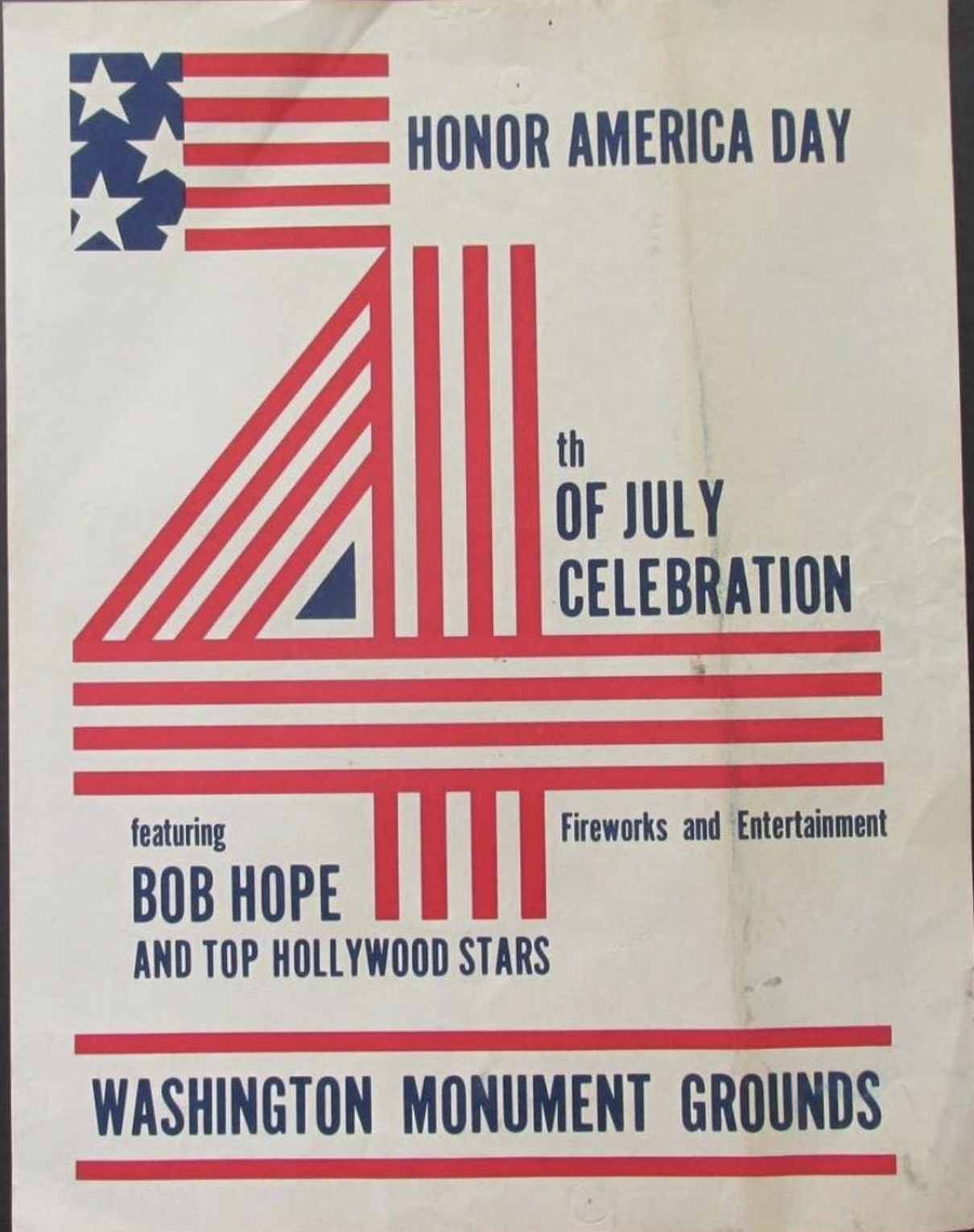
The prominent involvement of the administration and its allies led many to dismiss the event as little more than a rally for the right. “While the ‘Honor America Day’ celebration in Washington has been advertised as nonpartisan,” the columnist Art Buchwald noted, “any professional politician knows that when the public sees Billy Graham, Bob Hope and Lawrence Welk on the platform, the Nixon Administration will be the only ones enjoying the fireworks.” But, of course, the target audience for the event was much larger than that. Members of the Silent Majority, upset by the turmoil of the 1960s, increasingly looked back to the stability of the 1950s with nostalgia. The religious rhetoric and rituals of the Eisenhower years had been key markers of that era’s seeming Cold War consensus with its conservative social values, and the Silent Majority readily seized onto them in hopes of rolling back the clock.[6]
Organizers continued to insist Honor America Day was for everyone, though qualifications increasingly colored their claims. Two days before the event, Graham and Marriott held a press conference at the Mayflower Hotel, site of the first National Prayer Breakfast, to note that the day was for all Americans who loved both God and country. “We’ve tried to get every shade of philosophy into the program,” Marriott said. “But we’re not after people who shine their shoes with the flag. I don’t think those people want to honor America.” Religious belief, of course, was a key part of that patriotism. “Only atheists and agnostics were not invited to participate,” Graham explained, “because they don’t believe in God.” Nevertheless, the minister extended an olive branch to the other side. Antiwar protestors surely loved their country, he said at the press conference, so they surely “would come out and wave the flag too.” In a sign of his sincerity, the night before the rally, Graham ventured out to the Washington Monument, to chat briefly with hundreds of radicals who had camped out for a “marijuana smoke-in” the next day. They offered the preacher some pot, but he declined. As he walked away, several flashed him a peace sign. In an echo of the president’s own impromptu meeting with students at the Lincoln Memorial, a single finger shot up in response. With Graham, however, it was an index finger, his friendly insistence that Jesus Christ was the one true way.[7]
As the Fourth of July dawned, with a forecast calling for high heat and humidity, crowds began converging on the capital. Special trains and nearly 500 chartered buses brought thousands from across the northeast, while a 500-car caravan made its way from Richmond, Virginia. Despite organizers’ insistence that the attendees would be diverse, they turned out to be overwhelmingly white, middle-class, and middle-aged. “The styles were straight,” a reporter for the Baltimore Sun wrote. “There were fewer black faces than one might have expected in Alaska.” This was the Silent Majority in the flesh. “They gathered in front of the Lincoln Memorial, where so many others have assembled in protest,” Time reported, “to bear witness that it was their country too, a country more right than wrong.” A woman in the crowd expressed the same sentiment, but in more confrontational terms. “The hippies have had their demonstration,” she said. “Now it’s our turn.”[8]
Honor America Day began, as planned, with the morning religious service at the Lincoln Memorial. Roughly 15,000 spectators attended, but the television networks broadcast the service, allowing thousands more to follow along at home. “It was like a small-town Fourth of July on a super scale,” the Washington Post noted, “with the favorite ordained men thoroughly fusing God and country.” Dressed in a blue-and-white striped suit with a red pocket handkerchief, Pat Boone led the crowd in the National Anthem. The Centurymen Choir of Fort Worth and the U.S. Army Band joined together to perform “America the Beautiful,” but Kate Smith stole the show with her rendition of “God Bless America.” For the scripture reading, Rabbi Marc Tanenbaum selected a passage from Chapter 25 of the Book of Leviticus, the same passage the Committee to Proclaim Liberty first used its Fourth of July festivities nineteen years earlier.[9]
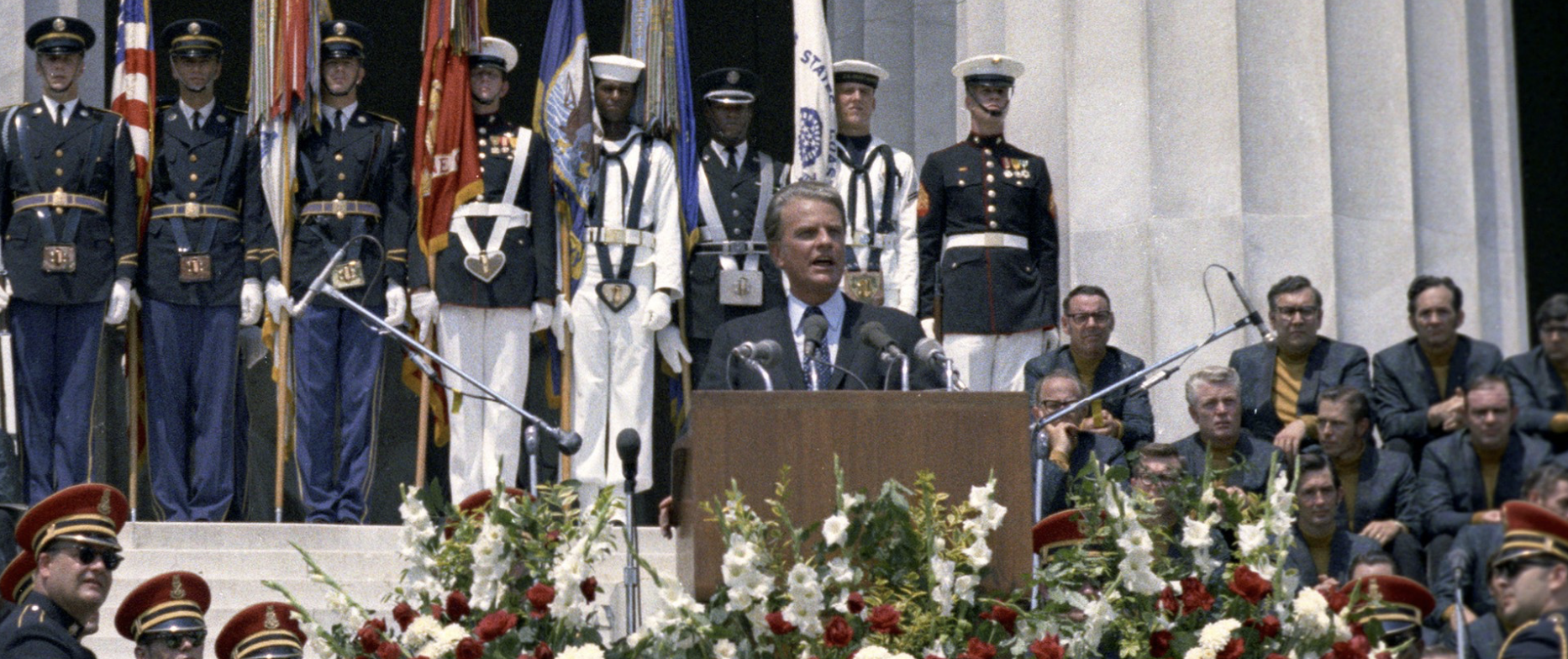
Graham, of course, was the main attraction. Standing in the same spot where Martin Luther King, Jr., had delivered his address to the March on Washington seven years before, the evangelist cast himself as an heir to the slain civil rights leader with a sermon unsubtly titled “The Unfinished Dream.” “We have listened and watched while a relatively small extremist element, both to the left and to the right in our society, have knocked our courts, desecrated our flag, disrupted our educational system, laughed at our religious heritage, and threatened to burn down our cities,” the preacher said. “The overwhelming majority of concerned Americans – white and black, hawks and doves, parents and students, Republicans and Democrats – who hate violence have stood by and viewed all this with mounting alarm and concern.” At long last, these once silent Americans were starting to speak out, “to say with loud voices that in spite of their faults and failures, we believe in these institutions! Let the world know that the vast majority of us still proudly sing: ‘My country ‘tis of thee / Sweet land of liberty!’” The crowd roared in approval.[10]
Graham insisted that the secular institutions of American life were worth defending because they were rooted in spiritual truths. “Why should I, as a citizen of Heaven and a Christian minister, join in honoring any secular state?” he asked. “The Bible says, ‘Honor the nation.’ As a Christian, or as a Jew, or as an atheist, we have a responsibility to an America that has always stood for liberty, protection, and opportunity.” In Graham’s view, those national values were no accident, but were instead rooted in the founding fathers’ explicit embrace of the Judeo-Christian tradition. “The men who signed the Declaration of Independence were moved by a magnificent dream,” Graham claimed. “This dream was rooted in a Book called the Bible. It proclaimed freedoms which most of the world thought impossible of fulfillment.” The founders’ vision had not been fully realized, he acknowledged, but it was within reach. “I call upon Americans to bend low before God and go to their knees as Washington and Lincoln called us to our knees many years ago,” he implored. “I submit that we can best honor America by rededicating ourselves to God and the American dream.” A return to religion, Graham argued, would bind the wounds of the nation and “stop this polarization before it is too late.”[11]
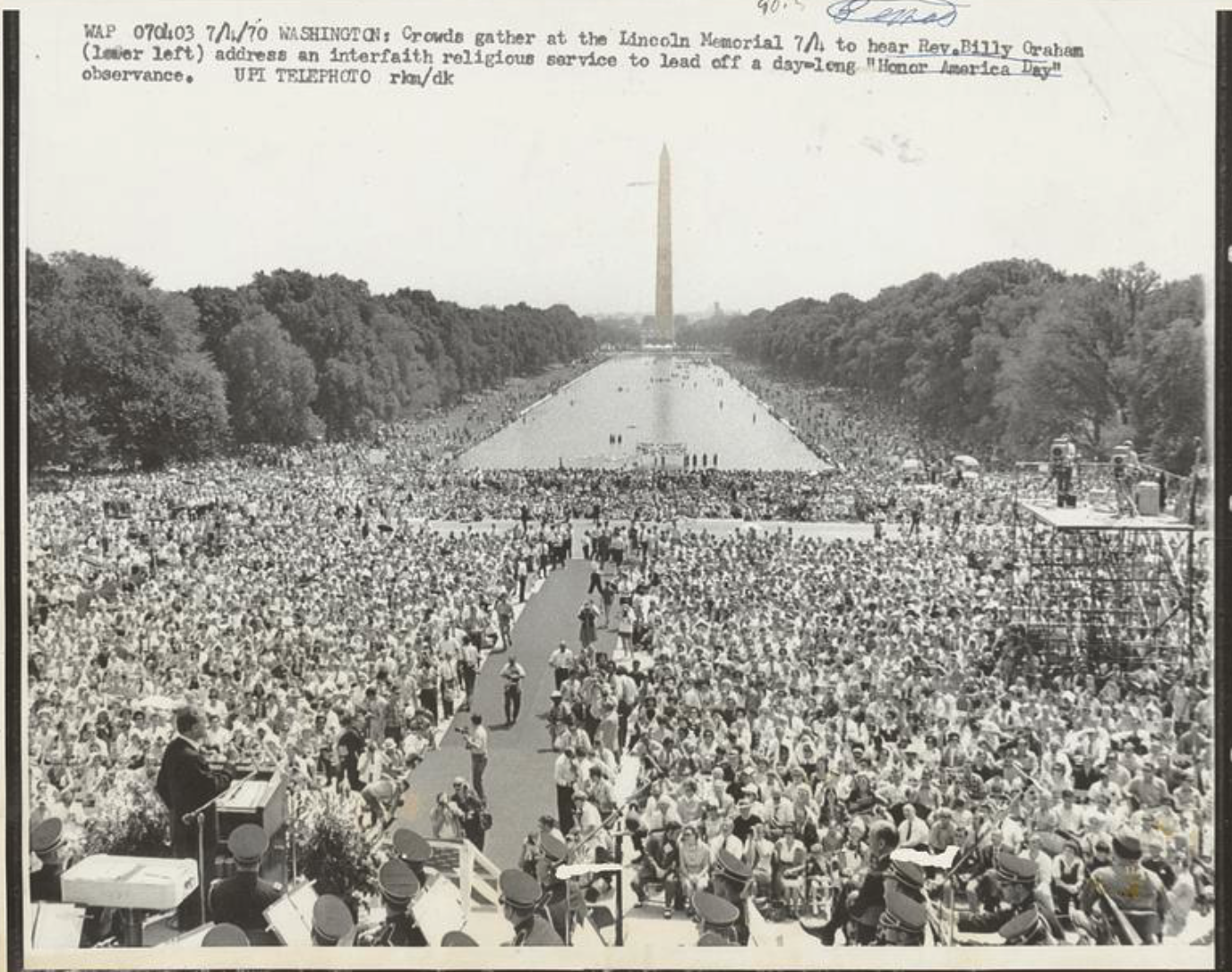
As Graham looked out from the Lincoln Memorial, though, it seemed it might already be too late. The crowd before him welcomed his message, but they had become increasingly distracted by a smaller contingent of radicals arrayed behind them. Roughly a thousand sprawled in the shadows of the Washington Monument, smoking red-white-and-blue joints and waving Vietcong flags. Though Graham had hoped to win them over, they still viewed him and his supporters with suspicion. (Speaking with a reporter, a young man with long brown hair and a drooping mustache referred to Graham’s clean-cut crowd as “the Americans.”)
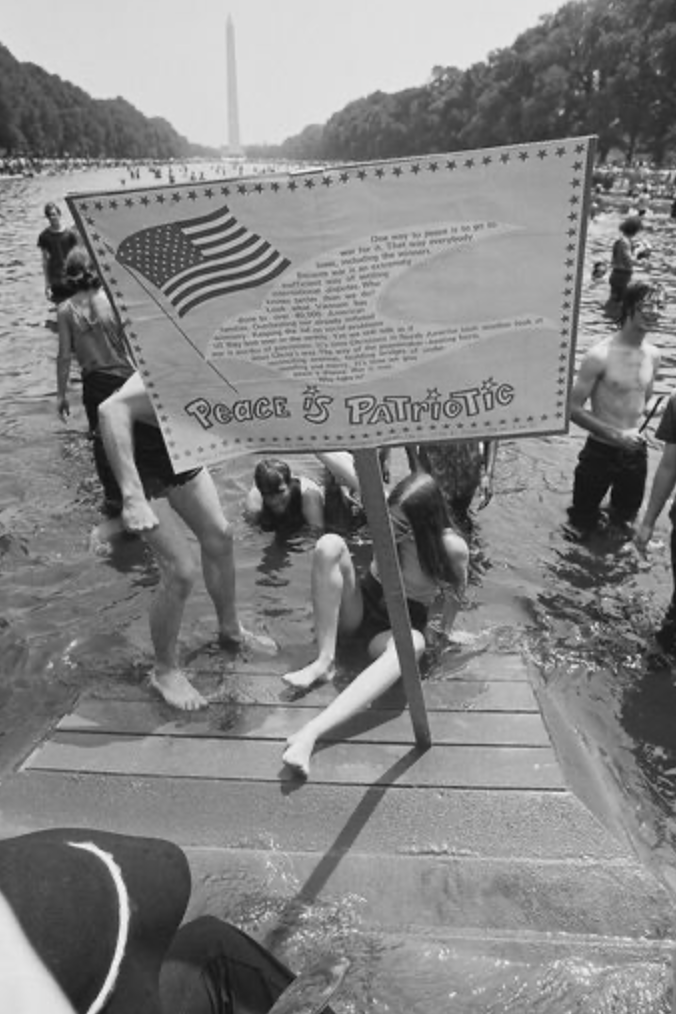
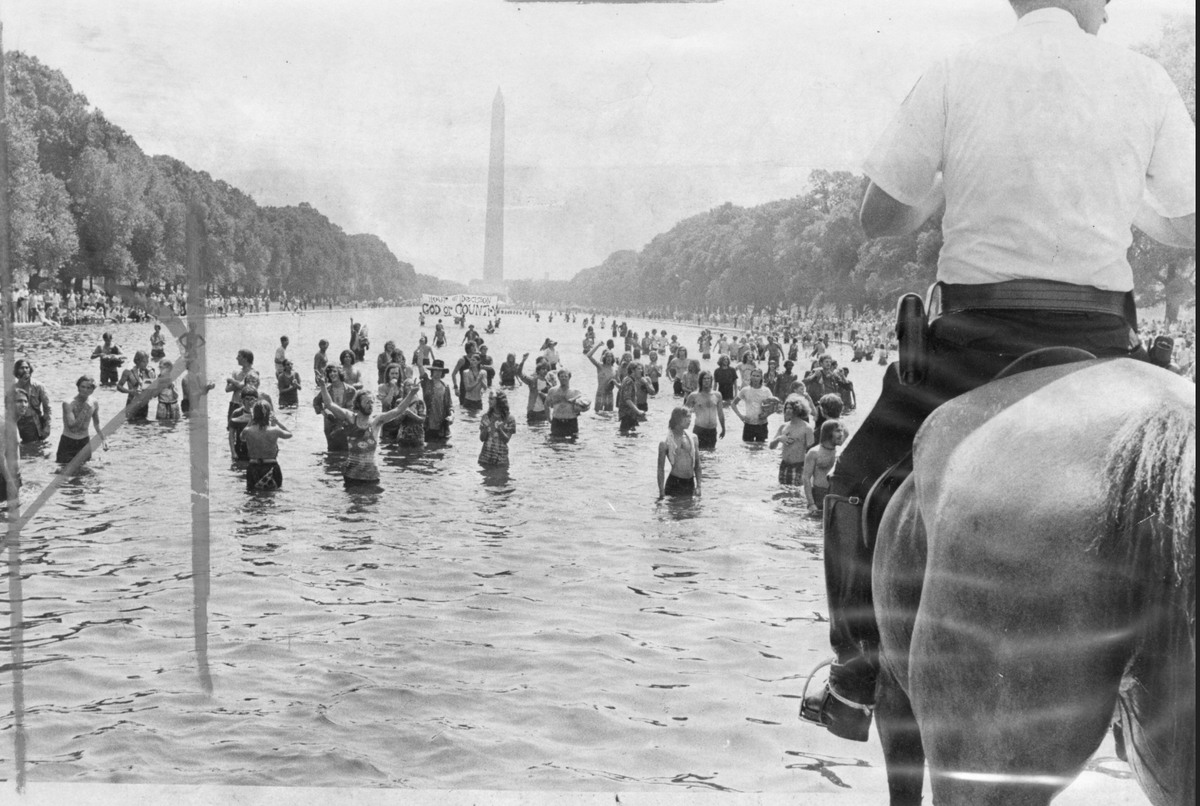
As the service went on, a few hundred radicals, some completely nude, waded waist-deep into the reflecting pool and launched into antiwar chants. At the near end of the pool, Graham’s audience watched with rising anger. Allen Brassill, a Kraft Foods salesman and chairman of the Americanism Committee of Maumee, Ohio, had driven to Washington with his wife the day before. “The speeches were inspiring,” he said, his eyes shaded by a straw hat with a small American flag tucked into the band. “But we haven’t enjoyed some of what we’ve seen here. Those filthy hippies in the pool, they should be locked up.” For others, confronting radicals was the entire point of the event. Jim Reilly, a fireman from Maryland, said it was “the main reason I’m here. I want to show those characters who are yelling obscenities that we don’t have to take anything from a small minority.” When mounted policemen finally intervened to keep the hecklers at bay, the conservative crowd cheered them on. “Push ‘em back,” yelled a man in yellow Bermuda shorts. “They can use a bath!” “They ought to be clubbed,” said a bald man in a striped shirt. An angry housewife upped the ante: “I hope they break a few necks, that’s what I hope.”[12]
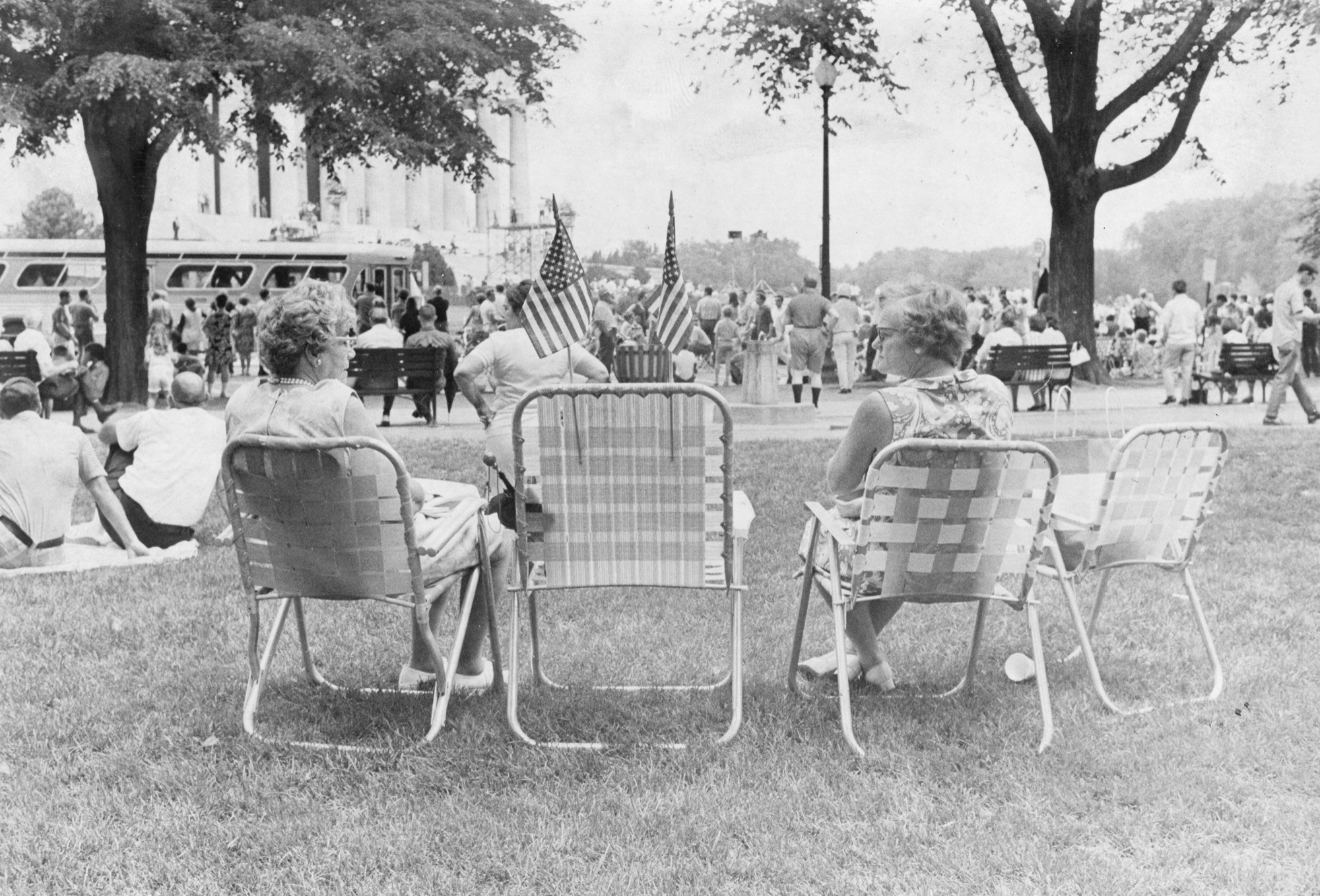
The disruption aside, Honor America Day continued as planned. Bishop Fulton Sheen brought the morning religious service to a close with his benediction. In a rebuke to the radicals in the reflecting pool, he proposed a West Coast counterpart to the Statue of Liberty, a “Statue of Responsibility” to “remind Americans that we have no rights without corresponding duties.” Fireworks screeched from behind the Lincoln Memorial, exploding in a colorful display that ended with tiny American flags, attached to parachutes, floating gently down to the crowd. As the speakers descended the steps, they joined the crowd in a procession down Constitution Avenue. U.S. servicemen and Boy Scouts led the way with the American flag and the flags of states and territories. Hippies stood on the sidelines chanting “One, two, three, four! We don’t want your fucking war!” but the color guard focused on reaching the Ellipse. “There,” Newsday noted, “on the very spot where students staged their bitter protest” two months before, Honor America Day participants raised a giant American flag. They then planted their small flags “into the letters U.S.A. which have been carved 42 by 24 feet into the green sod.” Relay racers who had set out the day before from Independence Hall, Colonial Williamsburg and Valley Forge soon arrived, planting their flags as well. As military bands performed throughout the afternoon, more and more members of the Silent Majority filed past, adding their individual flags to a growing “sea of red, white and blue” and reclaiming the Ellipse from the radicals.[13]
That evening, Honor America Day moved to the Washington Monument. Despite a late afternoon thunderstorm that soaked the lawn and drove the humidity even higher, the crowd only continued to swell. American Legionnaires, unmistakable with their caps displaying their names and post numbers, turned up in clusters across the crowd. A group of short-haired high-school kids in hard hats loudly sang patriotic songs; empty beer cans piled up beside them. Teams of Boy Scouts rushed around providing first aid to those suffering in the heat, while roughly 500 members of the conservative Young Americans for Freedom sported armbands that identified them as official “information aides” for the event. By nightfall, park police estimated that over 350,000 had gathered for the evening’s entertainment, forming a thick carpet of people, picnic baskets and blankets that stretched out from the spotlighted monument a half-mile in all directions.[14]
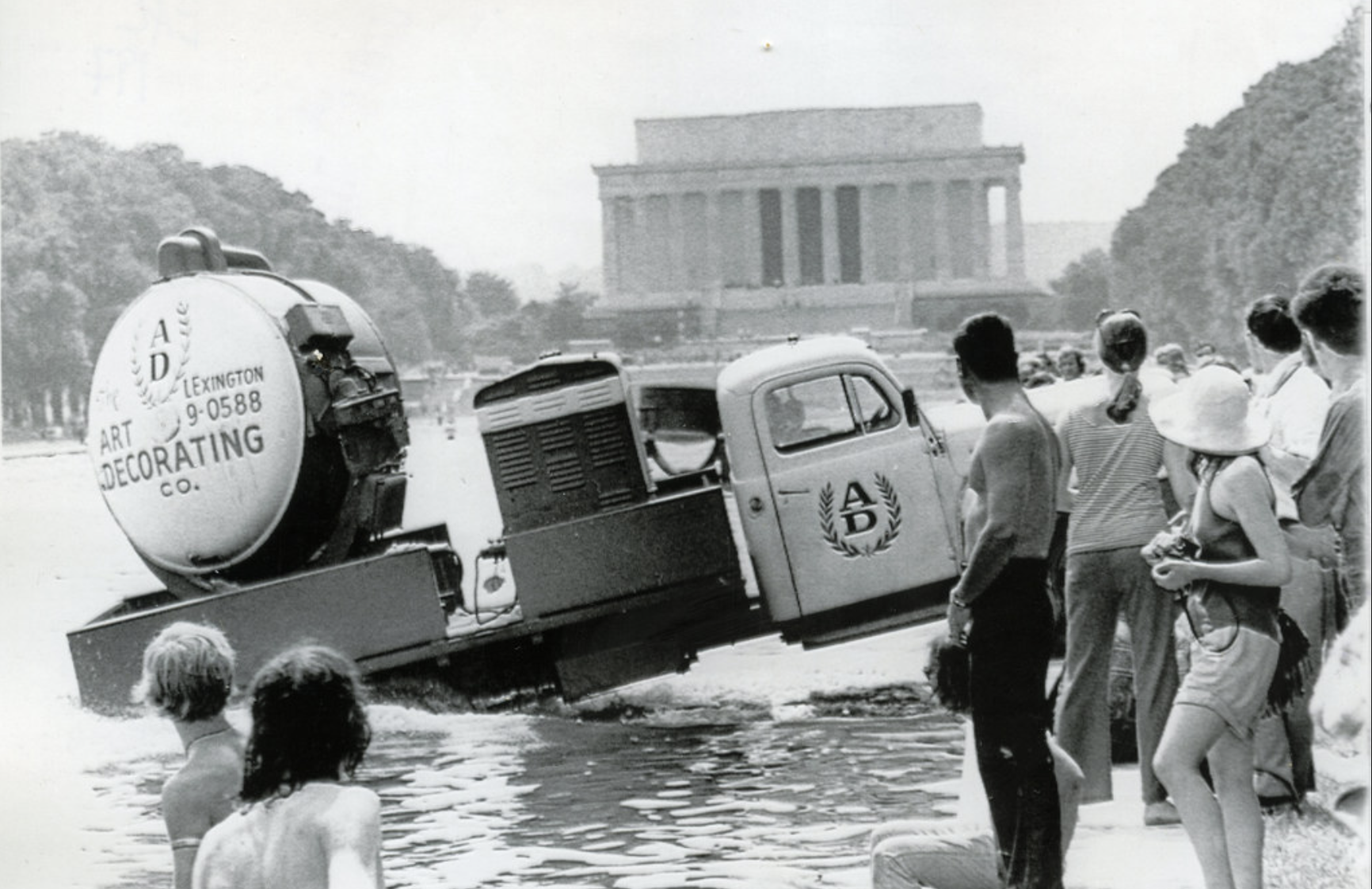
The few thousand antiwar protestors, now badly outnumbered, had been pushed to the fringes. Nevertheless, they had grown bolder over the afternoon, “liberating” a concession stand, raiding two Pepsi trucks and, most improbably, flipping a giant spotlight into the reflecting pool. “The police are under orders to play it cool, to lean over backwards to avoid violence,” a Time reporter explained in a wire to his office. Policemen tried to preserve the “DMZ” between the Honor America Day crowd and the radicals taunting them, but when a small group of protestors started throwing rocks, bottles and cherry bombs, they moved in. As the U.S. Navy Band began the Star Spangled Banner, parks police launched tear gas into the thicket of protesters. They misjudged the wind, however, and the smoke swept over the celebration’s attendees. “To the final strains of the anthem,” a reporter wrote, “there was a mad stampede of weeping hippies and Middle Americans away from the fumes.”[15]
When the evening’s entertainment began, the crowd tuned out the protesters at the perimeter. As promised, master of ceremonies Bob Hope kept the program largely apolitical, though partisanship occasionally crept in. A prerecorded message from Nixon drew applause and a scattering of boos from the back, and when Hope set up a joke about a possible monument to Agnew, the crowd interrupted him, cheering the premise more than the punch line. On a few occasions, however, the political emphasis was quite overt. Country singer Jeannie C. Riley, best known for her hit “Harper Valley PTA,” a send-up of small-town hypocrisy, performed Merle Haggard’s Silent Majority anthem “The Fightin’ Side of Me” instead. “If you don’t love it, leave it: Let this song that I'm singin’ be a warnin’,” she sang to sustained cheers. “If you're runnin’ down my country, man, you’re walkin’ on the fightin’ side of me.” Later, comedian Red Skelton recited the Pledge of Allegiance, defining each word at length as he went. “Since I was a small boy,” Skelton observed at the very end, “two words have been added to the Pledge of Allegiance: ‘Under God.’ Wouldn’t it be a pity if someone said that is a prayer and that be eliminated from our schools, too?” At this, the crowd came alive, whistling and hooting.[16]
For the most part, though, the performers stuck to traditional patriotic routines. Dinah Shore, who had been picked up from the Washington airport and whisked to the vice president’s mansion the day before, played it straight with a standard rendition of “America the Beautiful.” The Centurymen Choir, participants in the morning program, returned with the sentimental “We’ll Find America.” Occasionally these anthems served as an ironic score for the chaos unfolding in front of the performers. While the earnest New Christy Minstrels performed a sanitized version of “This Land is Your Land,” the crowd watched parks police handcuff a black teen and usher him into a paddy wagon. In the end, only the magnificent final fireworks display brought all the crowd together, however briefly, in a shared moment of awe. And as soon as it was over, the two sides went their separate ways.[17]
The next day, the men behind Honor America Day were quick to pronounce it a major success. “It was a great Fourth of July celebration,” Nixon claimed, “the kind of patriotic thing we need.” Organizers were thrilled that the size of the crowd had lived up to their highest hopes, despite the brutal weather. The television audience at home was even more encouraging; three-quarters of TVs in Washington had tuned in, and countless more across the country. Marriott had no doubts that the event had resonated with its target audience. “The people who attended were nice looking,” he reflected the next day. “They were Middle Americans, the backbone of the country. That’s what thrilled me.” (As for the antiwar protesters, he had a different take: “It’s too bad we have to have people like that trying to destroy the country.”) To spread the message more broadly, organizers made arrangements for the production of a special two-disc collector’s album of the event titled Proudly They Came … To Honor America. The recording was narrated by actor Jimmy Stewart, in echoes of his earlier service as emcee of the “Freedom Under God” festivities decades earlier. The Capitol Record Club soon made the double album its selection of the month and had to send out “reservation certificates” for copies when demand far surpassed the original supply. Meanwhile, Nation’s Business, a publication of the United States Chamber of Commerce, started selling copies of the record as well. All things considered, Marriott reflected, the event had been “very successful.”[18]
Those outside the administration’s orbit disagreed. “Successful at doing what?” the editors of Newsday asked. “Bringing America together? Perhaps. But which America? Certainly not those who would not or could not go. Not those whose attempts to disrupt the affair with their obscenities and harassment and hurling of fireworks so aggrieved the participants that some returned to their homes muttering things like: ‘Now we know who the enemy is.’” Some critics believed the event had succeeded, at least in terms of its unacknowledged political agenda. “The ‘Honor America Day’ rally brought them together, all right,” columnist Mary McGrory noted, “and sent them away farther apart than ever.” Reporters for the Washington Post agreed, concluding that the Fourth of July festivities had simply “illustrated, perhaps better than any study or commission could, the polarization of American society.”[19]
[1] WP, 5 June 1970; BS, 19 June 1970; NYT, 24 June 1970.
[2] Gibbs and Duffy, The Preacher and the Presidents, 188; WP, 28 June 1970; BS, 28 June 1970.
[3] WP, 5 June 1970; Handwritten Memorandum, “Contributing Corporations,” [n.d., June 1970], Box 173, John Willard and Alice Sheets Marriott Papers, Special Collections and Archives, J. Willard Marriott Library, University of Utah, Salt Lake City, Utah (hereafter cited as “JWM”); Memorandum, Larry Higby to H.R. Haldeman, 19 June 1970, reprinted in Oudes, ed., From the President, 142; Memorandum, “Contributors—Corporations,” [n.d., June 1970], Box 173, JWM.
[4] Gibbs and Duffy, The Preacher and the Presidents, 188; Transcript, Exit Interview with Ronald H. Walker, conducted by Susan Yowell, 29 December 1972, Richard M. Nixon Presidential Library (http://www.nixonlibrary.gov/virtuallibrary/documents/exitinterviews/walker.php; accessed 20 November 2013); NYT, 4 July 1970.
[5] WSJ, 3 July 1970; BG, 2, 12, 16, 26, 27, 28 April, 14 June 1970; BS, 27 April 1970; Program, Honor America Day, 4 July 1970, Box 178, JWM.
[6] LAT, 30 June 1970.
[7] NYT, 3, 4 July 1970; Gibbs and Duffy, The Preacher and the Presidents, 188; WP, 3 July 1970.
[8] Newsday, 3 July 1970; BS, 5 July 1970; Time, 13 July 1970; WP, 5 July 1970.
[9] WP, 5 July 1970; Program, Honor America Day, 4 July 1970, Box 178, JWM;
[10] Billy Graham, “The Unfinished Dream,” speech transcript, 4 July 1970, Box 222, BGEA: Crusade Activities Collection, Billy Graham Center Archives, Wheaton, Illinois (hereafter cited as “BGCA”).
[11] Billy Graham, “The Unfinished Dream,” speech transcript, 4 July 1970, Box 222, BGCA.
[12] Newsday, 6 July 1970; Arthur White, Telex Report, “Honor America Day—Take 7,” 4 July 1970, Box 16, Arthur White Collection, Archives and Special Collections, Odum Library, Valdosta State University, Valdosta, Georgia (hereafter cited “AW”); WP, 5 July 1970.
[13] Arthur White, Telex Report, “Honor America Day—Saturday updating—Take V,” 4 July 1970, Box 16, AW; Newsday, 3 July 1970; Schedule, “Honor America Day,” [n.d., July 1970], Box 178, JWM.
[14] Newsday, 3, 6 July 1970; BS, 5 July 1970; BG, 5 July 1970; Arthur White, Telex Report, “Honor America Day—Saturday updating—Take six,” 4 July 1970, Box 16, AW.
[15] Arthur White, Telex Report, “Honor America Day—Saturday updating—Take V,” 4 July 1970, Box 16, AW; Newsday, 6 July 1970; Arthur White, Telex Report, “Honor America Day—Saturday updating—Take six,” 4 July 1970, Box 16, AW.
[16] Audio Recording, “Proudly They Came to Honor America,” 1970, copy in author’s possession; CT, 5 July 1970.
[17] Newsday, 6 July 1970.
[18] WP, 6, 7 July 1970; LAT, 6 July 1970; Kenneth Shaw to “Dear Member,” [n.d., 1970], Box 177, JWM; Capitol Record Club, “Reservation Certificate,” [n.d., 1970], Box 177, JWM; “Proudly They Came…” advertisement, Nation’s Business (July 1971), copy in Box 179, JWM.
[19] Newsday, 7 July 1970; BG, 6 July 1970; WP, 5 July 1970.