Rededicate* 250
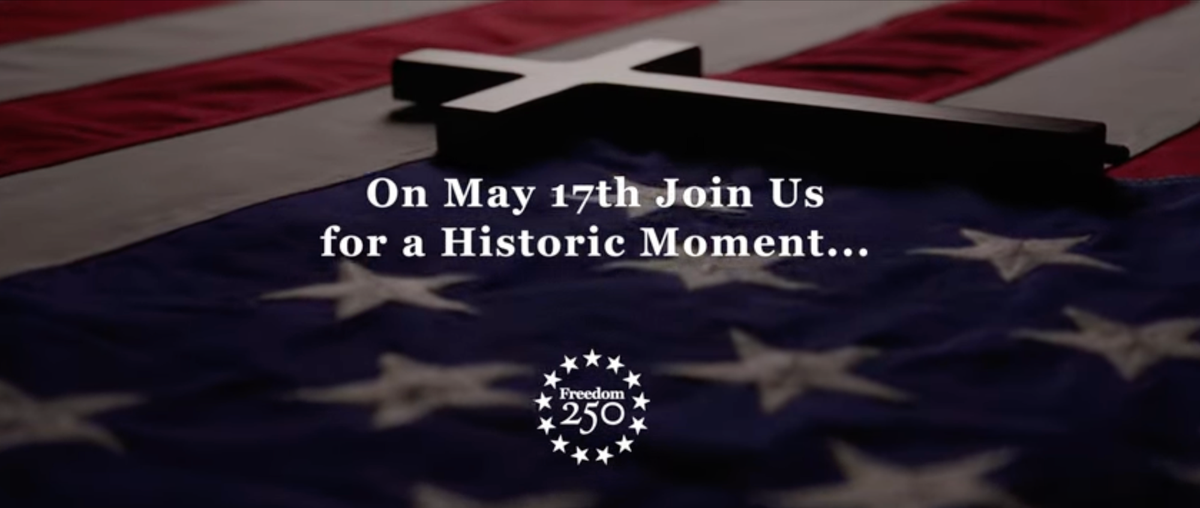
This coming Sunday, the Trump White House is holding "Rededicate 250," a massive religious event on the National Mall in Washington, D.C., designed to "give thanks for God's providence, reflect on our nation's story, and rededicate America as One Nation under God."
While it's not even the most disturbing bit of Religious Right news this week – that honor has to go to evangelical leaders dedicating a literal golden idol to their god – it's still a stark reminder of how far down the road to Christian nationalism this administration has taken us.
No other administration in American history would have been so explicit in the effort to wrap the cross up in the flag as that banner image, the opening shot of the Rededicate 250 video does.
But the Trump administration apparently wants to assert that this level of Christian is normal and that we've somehow departed from it. This event is being pointedly promoted as a rededication. The obvious implication is that someone important – the Founding Fathers™, or maybe the Son of God himself? – originally dedicated America as "One Nation Under God" and now they're just getting us back on track.
But as I chronicled in my book with that title, the phrase "One Nation Under God" – like so much of our nation's public expressions of piety – only came about in the 1950s.
Despite MAGA efforts to promote the phrase in celebrating the 250th anniversary of the Declaration of Independence, it's not remotely that old. Hell, it's not even as old as our dementia-ravaged president. (Indeed, the words "under God" were only added to the Pledge of Allegiance when Donald Trump was in the third grade.)
If the promotional video is any guide, the Rededicate 250 event will be yet another effort to assert that because there were religious references from some "founders" during some parts of the revolutionary era, that means that they were deliberately building a Christian nation.
It's right there in the opening line of the video, where a minister insists that "our nation was conceived by men and women who believed in the power of God, and the providences of God, and the power of prayer."
Well, sure, some of the founding fathers believed in the power of God, but several prominent ones did not. Thomas Paine was an atheist, Thomas Jefferson took a razor to his Bible to cut out all the miracles, and many more were deists who took a rather broad view of divine intervention. (These people like to note that Benjamin Franklin suggested they all pray at one session. They never note that the motion failed without even getting a second.)
But even if we assume that the founding generation was all of one mind on faith, that they were all devout Christians who would feel right at home today hearing that sermon in an evangelical megachurch, that doesn't prove that they wanted a nation devoted to Christ. (It'd be like saying "our nation was conceived by men and women who wrote by candlelight and rode horses" and concluding that we should follow their example there, too.)
Again, sure, many of them believed in God and prayer. But all of them had seen what the infusion of religious faith – specifically, a messianic crusading Christian faith – had done to the governments of Europe during their own time. And that's why when it came time to write the Constitution, they produced a document that only mentioned religion three times and, every single time, mentioned it in a way that made it abundantly clear they didn't want the United States of America to be anything remotely resembling a "Christian nation."
First and foremost, there's the ban on all religious tests for office – a clear sign of the influence of the Enlightenment and a stark departure from previous norms – right there in Article VI of the Constitution: "no religious Test shall ever be required as a Qualification to any Office or public Trust under the United States."
Second, and more important in the public mind for centuries, was the twinned statements in the First Amendment that "Congress shall make no law respecting an establishment of religion, or prohibiting the free exercise thereof."
That's it. That's all the religion in the Constitution: No religious test for office holders; the state they led couldn't force a national religion on its people; the people were free to worship however they wanted.
In case that wasn't clear, the federal government spelled it out clearly in the Treaty of Tripoli. A document begun by Washington, signed by Adams, and ratified by a Senate whose membership was half-filled with ratifiers of the Constitution, the Treaty puts it in plain English for anyone who missed it: "the government of the United States of America is not in any sense founded on the Christian Religion."
So when these people talk about "rededicating" the USA to its rightful place as "one nation under God," remember that they have no legitimate claim. The politics they're trying clumsily to recreate comes not from the founding fathers in the 1770s, but from the era of our grandfathers and great-grandfathers in the 1950s.
But, again, as I noted in the book, even that era's religious nationalism was not narrowly focused on Christianity in general (or evangelical Protestantism in particular as this group is).
There were numerous expressions of religious nationalism in the 1950s – ranging from the addition of "under God" to the Pledge and the adoption of "In God We Trust" as the national motto to events like the National Prayer Breakfast – but these expressions were always drawn broadly. They invoked God, but never Jesus.
It was an approach, as Yale Law School Dean Eugene Rostow put it, marked by "ceremonial deism." The deity was always drawn as broadly as possible, so that Protestants, Catholics and Jews could all find meaning in it, but also Muslims, Hindus and Buddhists. (The only ones outside the circle were American atheists, whom President Dwight Eisenhower once called "a contradiction in terms.")
Unlike the Trump era, where expressions of sharp-elbowed evangelical Christianity dominate the discourse, the religious nationalists of the Eisenhower era were much more circumspect about foregrounding Christianity this much.
A good example of this came to mind when I saw that Rededicate 250 was scheduled for May 17th. As I noted in my book (full excerpt below), on that exact date in 1954, a subcommittee of the Senate considered a constitutional amendment that would have officially recognized "the authority and law of Jesus Christ, Saviour and Ruler of nations through whom are bestowed the blessings of Almighty God."
The same Congress that enthusiastically added "under God" to the Pledge with no hesitation proved deeply resistant to crossing this line, to declaring that the USA was officially a "Christian nation" as the MAGA crowd now desires.
This is not an effort to rededicate the nation to Christ, or even to God. It's an effort to deceive the country into thinking it was always meant to be dedicated that way.
There are few quiet days in Washington, D.C., but the Monday of May 17, 1954, was particularly frantic. For nearly a month, some twenty million Americans had been watching the dramatic showdown between Senator Joseph McCarthy and the United States Army, in congressional hearings broadcast live on ABC and the DuMont Network. But that morning, President Eisenhower stunned the nation by barring all Pentagon officials from testifying and, suddenly, McCarthyism’s climactic battle came to an abrupt halt. Then, only hours later and a block away, the United States Supreme Court issued its long-awaited ruling in the school desegregation case of Brown v. Board of Education. At 12:52 p.m., Chief Justice Earl Warren began delivering the unanimous opinion that tore down the constitutional foundation for racial segregation, speaking slowly but surely in awareness of the moment’s importance. When he finished at 1:20 p.m., wire services sent the news across the nation as the Voice of America trumpeted it around the globe in thirty-four languages. Riveted by these events, reporters gave little thought to the hearings taking place that afternoon in Room 424 of the Senate Office Building, where a subcommittee of the Judiciary Committee sat to consider a proposed amendment to the Constitution of the United States. If passed, it would have declared that “This Nation devoutly recognizes the authority and law of Jesus Christ, Saviour and Ruler of nations through whom are bestowed the blessings of Almighty God.”[1]
The campaign for this “Christian amendment” had been underway, in fits and starts, for nearly a century. Like most efforts to add religious elements to American political culture, the idea originated in the Civil War. In 1861, several northern ministers came to believe that the conflict was the result of the godlessness of the Constitution. “We are reaping the effects of its implied atheism,” they warned, and only a direct acknowledgment of Christ’s authority could correct such an “atheistic error in our prime conceptions of Government.” These clergymen banded together to create the National Reform Association, an organization that was single-mindedly dedicated to promoting the Christian Amendment. It won the support of prominent governors, senators, judges, theologians, college presidents and professors. “It can never be out of season to explain and enforce mortal dependence on Almighty God,” Senator Charles Sumner of Massachusetts applauded. Despite his own frequent invocations of faith, however, Lincoln ignored the calls for an amendment and the effort stalled. Campaigns devoted to the cause appeared sporadically in the decades that followed, but they too all failed to find traction.[2]
The religious revival of the Eisenhower era, however, gave this long-frustrated movement its best chance yet. In 1954, Republican Senator Ralph Flanders of Vermont advanced a new version of the amendment in what would be its latest and greatest campaign. Bald with a short, sandy-colored moustache, wire glasses and a pipe perpetually in hand, the soft-spoken 73-year-old did not look the part of a conservative firebrand. But his convictions ran deep. A former industrialist and head of the Federal Reserve Bank in Boston, Flanders had been an outspoken opponent of the New Deal, which he believed was designed “to establish permanent Federal control over business.” “A fundamentalist on free enterprise,” in the words of a Saturday Evening Post profile, Flanders was no different when it came to his faith. Soon after his arrival in Washington, he became a loyal ally of Abraham Vereide, serving as a regular participant in the Senate prayer breakfasts and then chair of his International Council of Christian Leadership (ICCL). Spurred on by these associations, the senator revived the Christian amendment and advanced it further along the legislative process than ever before. Though overlooked at the time, the 1954 Senate hearings represented a major milestone.[3]
Despite such progress, advocates of the Christian amendment still faced an inherently difficult challenge in the Senate. By its very nature, their proposal to change the Constitution forced them to acknowledge that the religious invocation was something new for the document. The founding fathers had felt no need to acknowledge “the law and authority of Jesus Christ,” and neither had subsequent generations of American legislators. Some of the more imaginative advocates of the Christian amendment at the Senate hearings simply waved away this history and argued that leaders like Washington and Lincoln had supported the idea even if they never acted upon it. For evidence, they repeatedly made reference in their testimony to letters and meetings in which these presidents allegedly lent support to their cause. At the hearings, the presiding senator kindly offered to have these documents inserted into the official transcript once they were found. But the published record provided a quiet rebuke to such claims, noting that inquiries to the Library of Congress and other authoritative sources showed that the alleged documents did not, in fact, exist.[4]
Other supporters of the Christian amendment took a different, if equally imaginative, approach to the issue of original intent. R.E. Robb, a newspaper columnist from South Carolina, compiled a collection of religious invocations from American history, stretching from the Mayflower Compact of 1620 to early twentieth-century America. From them, he testified that “we are warranted in stating categorically that this is in fact basically and fundamentally a Christian nation.” “But,” Robb admitted, “the Nation itself does not say so. Its official spokesman, its written or enacted Constitution, is silent on the subject.” No matter, there was another “unwritten and vital” constitution whose authority superseded the written one. “The vital, the actual Constitution of this Nation is and always has been Christian, from the first settlers down to the present,” Robb argued. “But the written Constitution, which should accurately reflect the vital Constitution, is sadly lacking in respect to its acknowledgment of Jesus Christ as the Supreme Ruler and His law as the supreme authority of the Nation.” Therefore, it needed to be amended.[5]
There was, according to advocates of the Christian amendment, ample evidence of the religious intent of this unwritten constitution, intent that had been expressed in a variety of official and unofficial ways. The head of the National Reform Association, a Presbyterian minister from Los Angeles named J. Renwick Patterson, presented the Senate with a litany of examples showing how “the spiritual has been woven into the fabric of American life” as part of the “unwritten law of the land.” He singled out the public prayers given in presidential inaugurations and congressional sessions, the chaplains employed by the military and Congress whose salaries were paid with public funds, the tax-exempt status of churches, and the traditional notion of Sunday as a day of rest. “All of these things testify to the place Christianity had had in the past and continues to have in our national life,” Patterson noted. “But when it comes to our Constitution, our fundamental law, there is complete silence regarding God. He isn’t even mentioned. There is no recognition, no acknowledgment. In our Constitution there is absolutely nothing to undergird and give legal sanction to the religious practices mentioned above.” Recognizing there was no constitutional authority for these activities, he argued not that these practices should be abandoned, but rather that the Constitution should be rewritten to support them.[6]
The 1954 campaign for the Christian Amendment failed like all the previous ones. Nevertheless, Patterson’s observations about religious references in American political life remained an important point. Two years earlier, in a unanimous opinion for the Supreme Court case of Zorach v. Clauson, Justice William O. Douglas had taken note of some of these same examples of public religiosity – “prayers in our legislative halls; the appeals to the Almighty in the messages of the Chief Executive; the proclamations making Thanksgiving Day a holiday; ‘so help me God’ in our courtroom oaths” – and asserted that they did not represent a violation of the First Amendment doctrine of separation of church and state. Notably, the liberal Douglas used these examples exactly as the conservative Patterson would in 1954: to draw a stark conclusion. “We are,” Douglas stated matter-of-factly, “a religious people whose institutions presuppose a Supreme Being.” The Constitution, the court seemed to say, might not officially acknowledge the authority and law of God, but neither would it object to any government official who did.[7]
A decade later, in a 1962 lecture at Brown University, Dean Eugene Rostow of Yale Law School referred to these extra-constitutional religious practices in American political life as “ceremonial deism.” His choice of words captured the conventional wisdom on these issues well. The invocation of “deism” called to mind the specific religious practice of many of the founding fathers, of course, but it also reflected the ways in which public acknowledgments of a deity tended to be vague and divorced from any particular sect. “God” was regularly invoked; “Jesus Christ” rarely, if ever. While other crusades for public religiosity had stressed a Christian identity – often an implicitly Protestant Christian identity, as seen in the work of Spiritual Mobilization or the International Council for Christian Leadership – the God celebrated in acts of ceremonial deism was more easily embraced by other faiths. Indeed, during the 1950s, Catholics played pivotal roles in spreading such religious symbolism, especially with the twin mottos that represented the pinnacle of the phenomenon: “In God We Trust” and “One Nation Under God.” Catholic congressmen wrote much of the key legislation that enabled these changes, Catholic fraternal organizations lobbied for their passage, and leaders in the Catholic clergy lent their support. Jews, for the most part, were supportive as well, with prominent rabbis and leading Jewish congressmen sanctioning the changes. Much like the public statements of President Eisenhower, the “deism” of such invocations welcomed a wide range of religious worship.[8]
Rostow’s framing of these religious references as “ceremonial” in nature was also telling. In the eyes of the law – even a stalwart liberal like Justice Douglas – these invocations were ceremonial in the sense that they were merely ornamental. They had no meaningful substance and, as a result, courts routinely held that those who objected to their use had no standing to challenge them. Legal scholars likewise dismissed the importance of these issues, as Rostow did when he characterized them as “so conventional and uncontroversial as to be constitutional.” Surprisingly, this attitude was echoed by the era’s most vigilant guardians of the wall separating church and state. The American Civil Liberties Union (ACLU), for instance, paid practically no attention to these issues when they were considered before Congress. As McCarthyism consumed the country, the ACLU focused its energies there. Protestants and Other Americans United for the Separation of Church and State (POAU), the most significant organization of its kind, worried largely about Catholic organizations seeking public money for parochial schools. Although they raised a few pro forma objections, these civil liberties organizations largely acceded to the argument, made often by proponents of ceremonial deism, that the First Amendment mandated the separation of church and state, not the separation of religion and politics. Support for a specific sect, especially when it came to the use of taxpayer money or government policy, was beyond the pale. But general support for the sacred was perfectly fine. Like many others, these civil liberties organizations believed official invocations of a vague “God” had no substance or significance.[9]
And yet, the “ceremonial” nature of public religious invocations did not diminish their importance. Quite the contrary, it vested them with incredible weight. In the eyes of many Americans, the official embrace of religion by the nation’s leaders was, in effect, as politically significant and legally binding as any formal amendment to the Constitution possibly could have been. This religious revival in government, which had begun in earnest with Eisenhower’s innovations, rapidly expanded as legislators got into the spirit. Though Congress dismissed the 1954 Christian amendment, during that very same session legislators enthusiastically and, indeed, effortlessly embraced religious mottos like “In God We Trust” and “One Nation Under God,” as well as a host of other changes that echoed and amplified this theme. These measures may not have had the legal impact of a constitutional amendment, but they were, for all intents and purposes, formal acknowledgments that the United States government recognized the law and authority of Almighty God. In the end, the “unwritten constitution” was written into American law and life after all.
[1] Chicago Tribune, 18 May 1954; Boston Globe, 18 May 1954; Richard Kluger, Simple Justice: The History of Brown v. Board of Educationand Black America’s Struggle for Racial Equality (New York: Vintage, 1975): 702, 708; U.S. Congress, 83rd Cong., 1st Sess., S. J. Res. 87.
[2] Morton Borden, “The Christian Amendment,” Civil War History (June 1979): 156-167; Kramnick and Moore, The Godless Constitution, 144-149.
[3] Ralph E. Flanders, Senator from Vermont (Boston: Little, Brown and Company, 1961): 122-131, 171-178; Flanders, “Business Looks at the N.R.A.,” The Atlantic Monthly (November 1933): 625-634; Ben Pearse, “The Case of the Unexpected Senator,” Saturday Evening Post (31 July 1954): 65; Flanders to Julius C. Holmes, 12 May 1952, Box 106, Ralph Flanders Collection, Special Collections Research Center, Syracuse University, Syracuse, New York (hereafter cited as “RF”); Flanders to Frank Carlson, 14 May 1952, Box 106, RF.
[4] See, for instance, Testimony of Mrs. P. de Shishmareff and A. J. MacFarland, U.S. Congress, Senate, 83rd Cong., 2nd Sess., Subcommittee on Constitutional Amendments, Judiciary Committee, “Proposing an Amendment to the Constitution of the United States Recognizing the Authority and Law of Jesus Christ,” 13 and 17 May 1954 (hereafter cited as “Christian Amendment Hearings”), 3, 25.
[5] Testimony of R. E. Robb, Christian Amendment Hearings, 26-31. Robb’s arguments on the “twofold” nature of the Constitution of the United States appear to have been considerably drawn from the work of the nineteenth-century Transcendentalist author Orestes A. Brownson. See Brownson, The American Republic: Constitution, Tendencies and Destiny (New York: P. O’Shea, 1866), especially Chapter X.
[6] Testimony of J. Renwick Patterson, Christian Amendment Hearings, 44.
[7] 343 U.S. 312-313.
[8] Epstein, “Ceremonial Deism,” 2091.
[9] Idem.