Masks Off
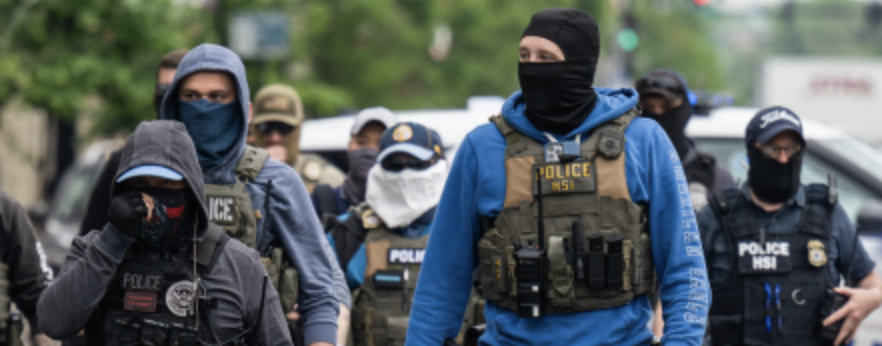
Over the past year and, in particular, over the past month, the United States has suffered an alarming rise in the number of verbal threats, physical assaults, and even murders committed by agents of the federal government against citizens and undocumented immigrants alike.
Encouraged to act irresponsibly by Acting President Stephen Miller and his allies in the whitest White House we've seen in a long time, these agents have repeatedly broken not just state and local laws but also long-standing federal ones as well.
In a comment that he made and then almost immediately denied making, Vice President J.D. Vance insisted that ICE agents could do whatever they wanted because they had "absolute immunity" and could never be held accountable.
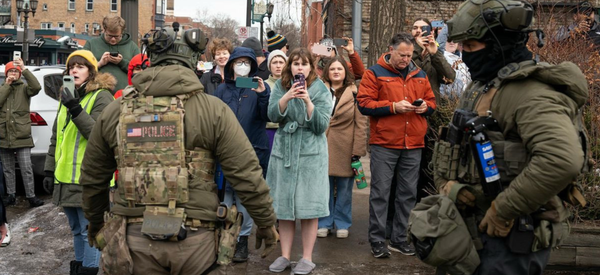
While they might not technically act with immunity, ICE agents are certainly acting with impunity these days. And that comes less from them having the cover of law and more with them having a literal covering of face masks that give them anonymity.
Federal agents have long refrained from wearing masks, presumably because of the general assumption that "good guys" don't. But there's technically nothing illegal about it yet.
Tom Homan, who holds the ill-defined and largely made-up position of "border czar" in the Trump regime, has insisted that they need to wear masks to avoid the "doxxing" of federal agents. This is, of course, ludicrous at several levels.
For starters, the concept of "doxxing" – revealing personal information from someone who has the right to remain anonymous – doesn't exactly apply to federal agents who are paid for with taxpayer money.
And while Homan insists his poor armed thugs need to remain anonymous, he's threatening to spread the names of individuals who dare to exercise their rights to observe and record ICE to their employers and neighbors. (This is a direct replay of the intimidation tactics used by the White Citizens' Councils, but Homan seems clueless that these people's communities back the resistance and would more than likely celebrate their roles than punish it.)
Despite the weak rationales for ICE's impunity, the American people aren't buying it. The recent batch of polls – conducted after the first ICE murder in Minneapolis, but before the second one – show the public turning strongly against ICE across the board, as the refrain of "Abolish ICE" speeds from the left fringe to the majority's point of view.
The political winds have shifted quickly after the second murder in Minneapolis. Greg Bovino, the scrappy little mascot for this fascist freak show, has been quickly dismissed from his post. Now Senate Democrats (and even a couple Republicans!) finding their spines to demand the resignation of Kristi Noem. That's a decent start, but only a start. The entire agency and indeed the entire department need to be torn down and all of its architects and their assorted henchmen need to be investigated and prosecuted as need be.
There's a lot of work ahead at the federal level, but much of the substantive work will have to wait until the Democrats regain some foothold in Congress or even the presidency.
In the meantime, though, Democrats at the state and local level can do something to help curb the violent excesses of ICE agents in their communities – they can put in place new laws that make wearing a mask itself a crime.
There's been a movement building here for a while now. In August 2025, Chicago Mayor Brandon Johnson signed a new law banning all law enforcement officials from wearing masks in that city. The state of California likewise passed a ban on masks in September, a ban which just went into effect this month and which the Trump administration is currently fighting in court. With several other states actively considering similar bans, we're clearly at an important crossroads.
Obviously, we'll have to see where the courts (especially the Roberts Six) land on this issue, but we should remember this debate is not remotely new.
Indeed, there are still old laws on the books from the last time a massive group of masked goons was terrorizing the country in a violent punitive campaign against racial minorities – the Ku Klux Klan. Their history reminds us that anti-masking laws have been widely embraced before, generally upheld by the courts, and routinely praised as reducing the incidents of violence and intimidation.
Between the 1920s and 1950s, more than a dozen states passed laws banning masks in public, as a concentrated effort to weaken the Ku Klux Klan simply by robbing the cowards of their anonymity and exposing their identities in public.
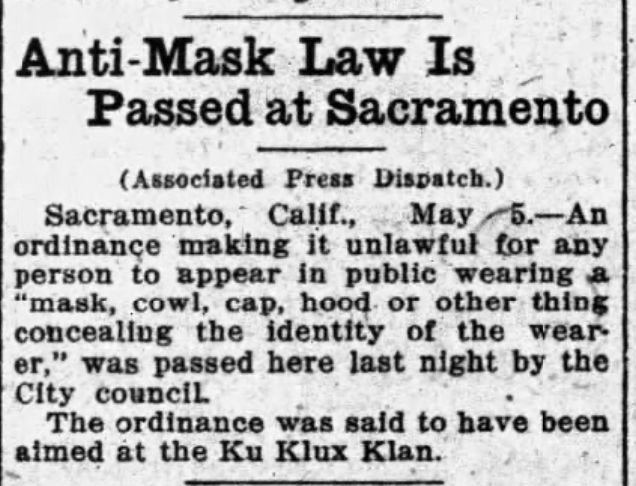
The "second Klan" of the 1920s was strongest in the Midwest and South, so naturally the movement to unmask the Klan began in the West and North. Here's an early account of a 1922 city ordinance in Sacramento:
Likewise, here's a piece on New York's anti-mask law, which was passed in 1923:
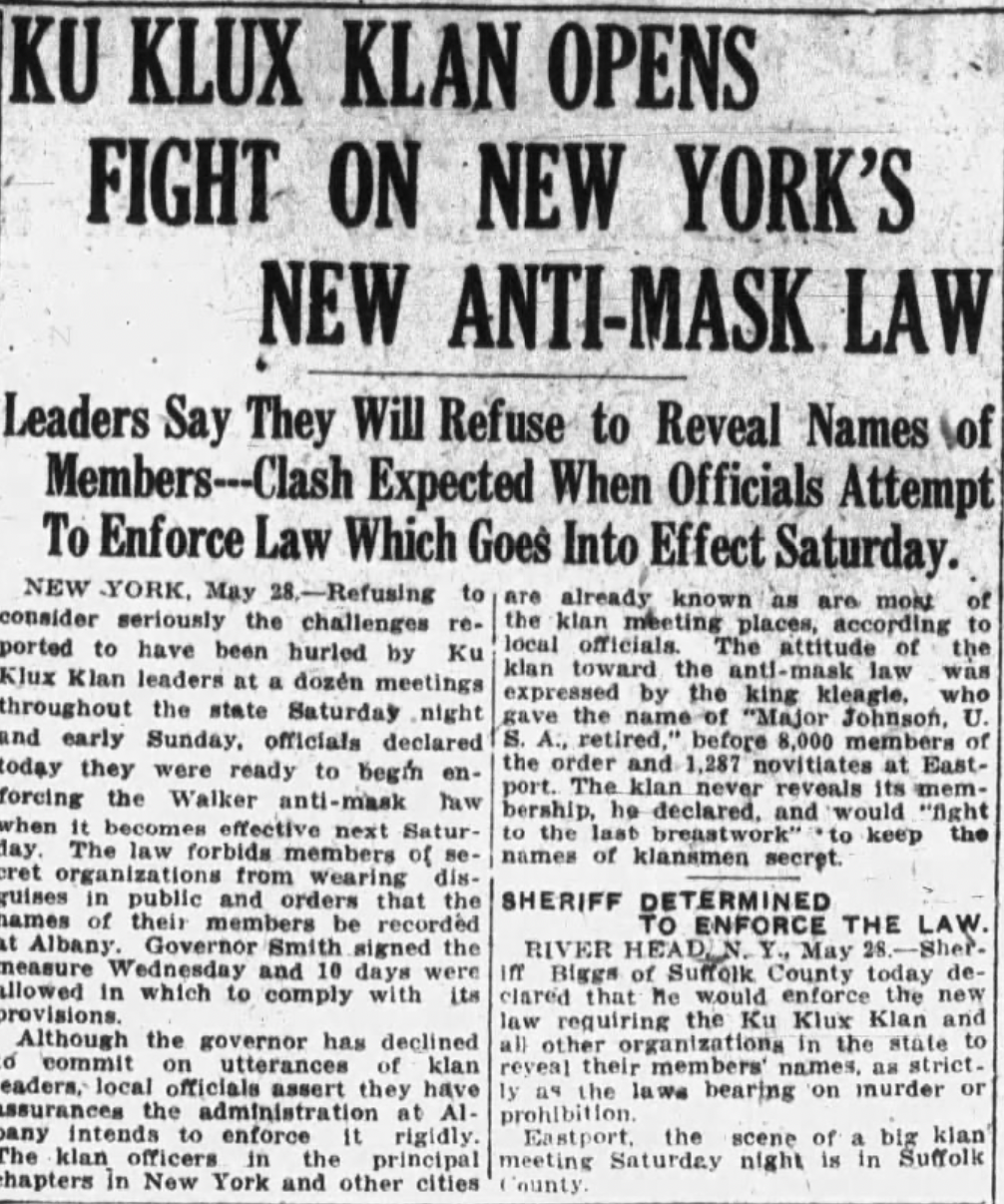
The experiment worked and helped chip away at the national prestige and influence of the organization. By the late 1920s, as the national power of the "second KKK" was already fading, anti-Klan elements in some southern states pushed through anti-masking laws as a sort of finishing blow.
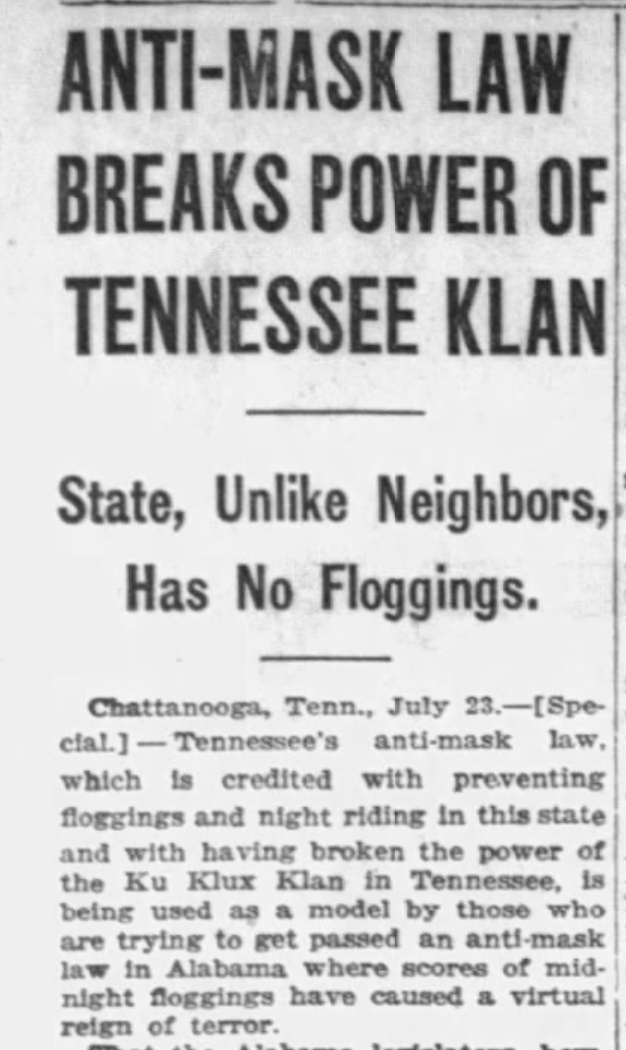
Here's a report on my home state of Tennessee from 1927:
When the Klan revived again in the aftermath of the Second World War, the movement for anti-masking revived as well. And this time, southern states were more amenable to the laws, as the "respectable" segregationists running them increasingly saw the Klan as a loose cannon whose violence and vulgarity brought discredit to the racist caste system of the region.
Here, for instance, is a piece on South Carolina Governor Strom Thurmond announcing that he would use the state's anti-masking law, passed in the 1920s, to combat the white supremacist order. (Yes, that Strom Thurmond.)
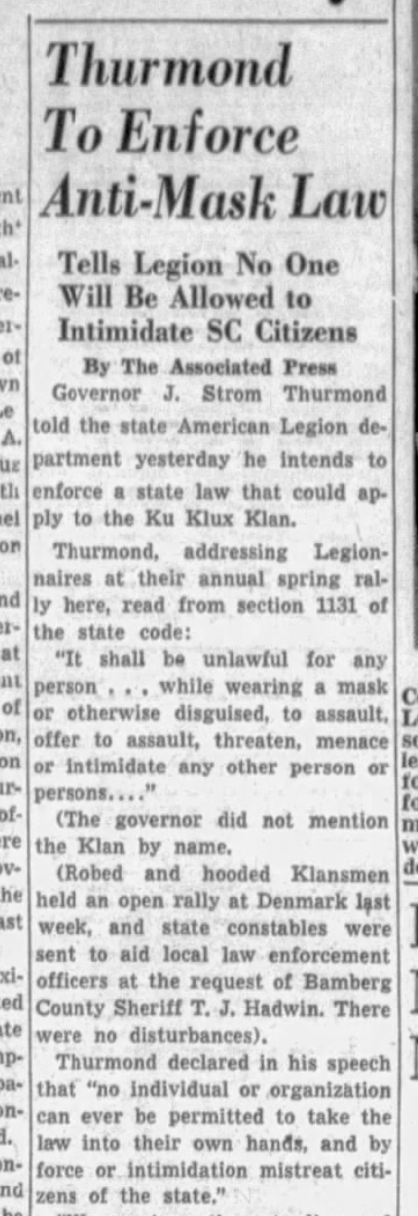
Other southern states and localities that hadn't passed laws in the 1920s now moved to join the new movement.
Here's a good, detailed account of where the movement stood in 1951, as several cities, plus Alabama and Georgia, moved to embrace the tried-and-true measure.
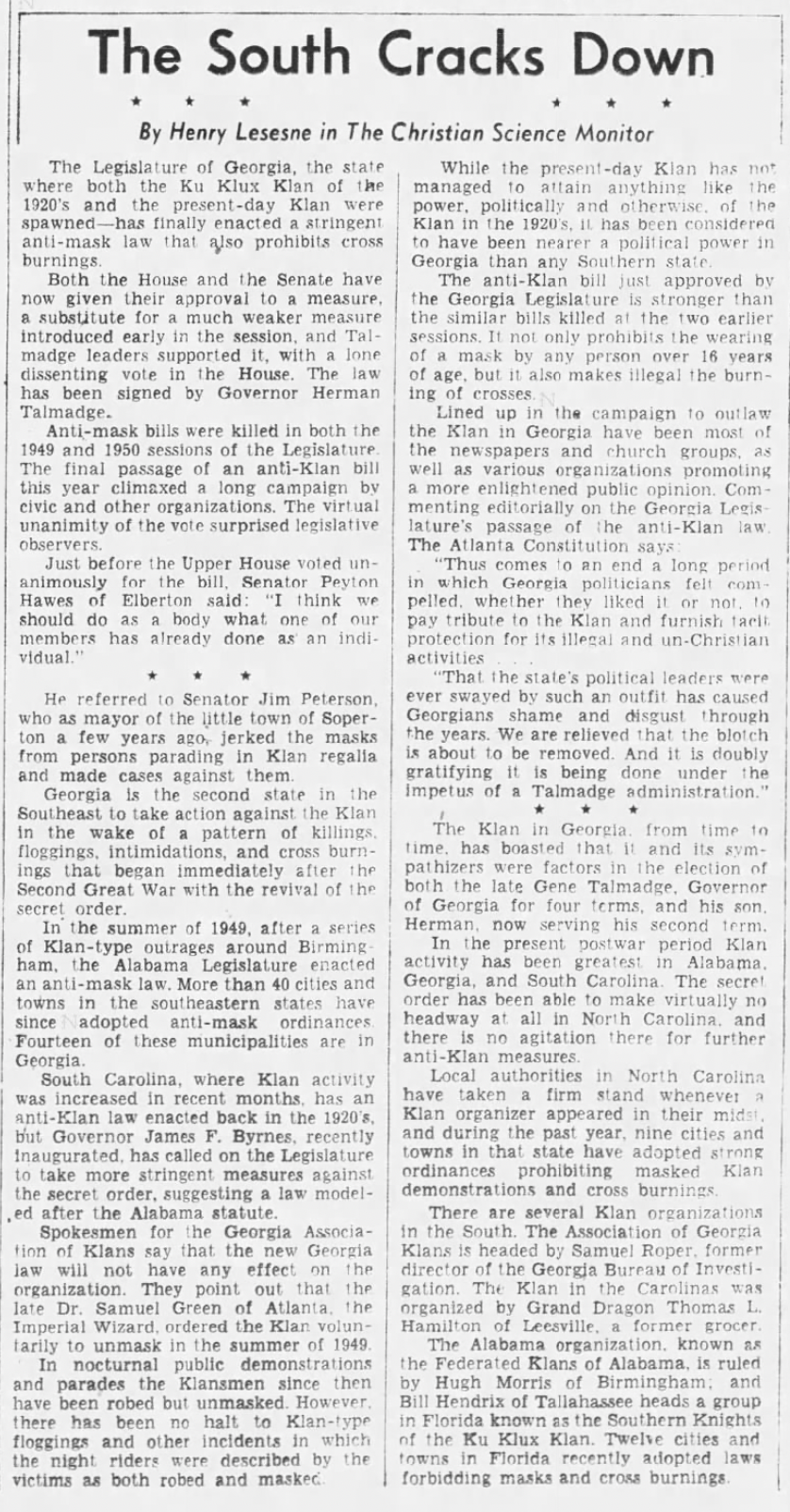
As the years went by, these anti-masking laws at the state and local level continued to reduce the Klan to uselessness.
As this report on a failed 1966 campaign in Rocky Mount, North Carolina, makes clear, the Klan was only "the Klan" when identities of individual men disappeared behind their uniform sheets and uniform masks; when their faces were visible, they were once again individuals, known to locals and not to be feared.
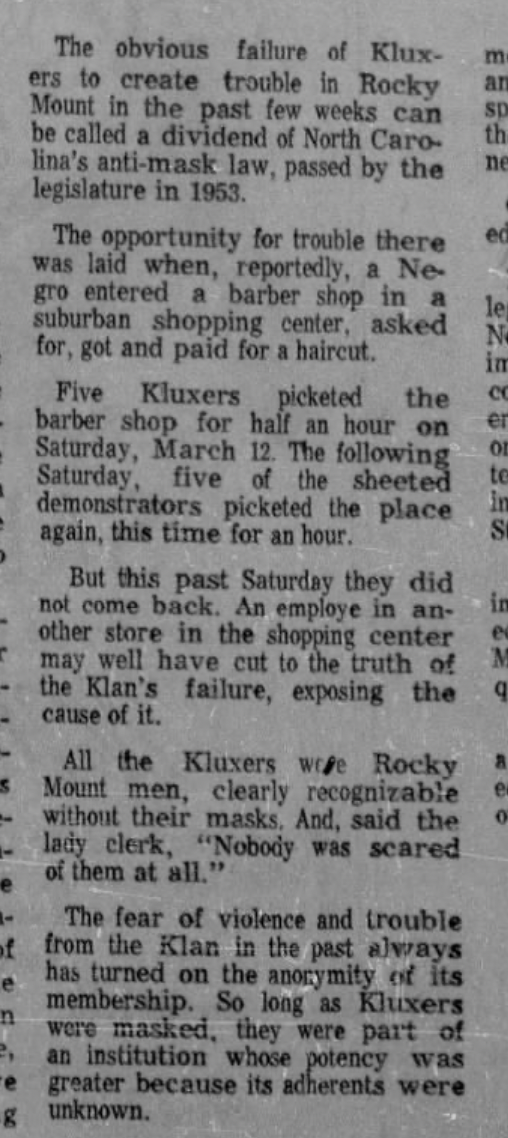
I should note that the anti-masking laws were just one part of the larger turn against the Klan, of course, and there was much more involved in bringing them down than this. But ripping off their masks was an early and quite effective first step, even if only part of a broader campaign to curb its power and reduce the harms it caused.
As America tries to rein in yet another masked order that purports to defend the country by enforcing a bloody, racist vision of nationhood, we should take stock of how we reined in the last one.
We have unmasked men like these before. We can unmask them again.