Boots on the Ground
The Trump administration and its allies have been busy for weeks now insisting that their war with Iran is not, technically speaking, a "war."
And now that this not-a-war war is likely expanding beyond air strikes to include the deployment of troops inside the region, they are busy telling us that this decision to put boots on the ground will not, in fact, be "boots on the ground."
The reasons for these frantic denials of reality are obvious.
If this conflict is defined as a "war," then constitutionally speaking, it needs to be declared as one – and not by the president, but by Congress. That's a mess that Trump and his loyal lickspittles in the congressional leadership both want to avoid. And, related to that, if ground troops are sent in, then it makes it a lot harder not to define it as a "war," ... which brings us right back to Congress.
Because they're engaged in these language games, it's worth giving that term some thought.
First and foremost, we should remember that the phrase "boots on the ground" in this context had its origins in a prior conflict with ... Iran.
Analysts of the military had deployed similar-sounding phrases before the 1979-1980 Iranian hostage crisis – a 1966 book by a British officer about Vietnam had a chapter titled "Feet on the Ground" – but it wasn't until the crisis that the precise phrase was used, and in reference to America's role in the regional conflict between Iran and Iraq as the hostage situation lingered on.
Here's a piece from the Christian Science Monitor, quoting four-star General Volney Warner:
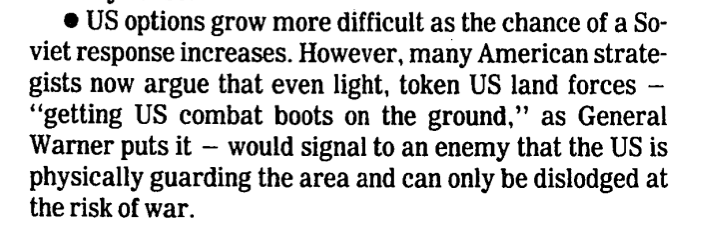
That phrasing, as you can see, frames "boots on the ground" as a deterrent to war, an action that would signal America's commitment to defending that ground and thereby scare off any challengers.
In the twenty-first century, however, the phrase "boots on the ground" has taken on a different meaning, one largely shaped by the use of that phrase to describe the deepening commitment of the Bush administration in the 2003 invasion of Iraq. (See here, here, here, here ...) It's not a show of force meant to deter a war; it's a show of force meant to deepen one.
And it's that meaning of "boots on the ground" that really has my attention, as the Trump administration seems intent on deepening American involvement in Iran and complicating its mission considerably.
This week, the administration has told reporters that it will likely deploy 2,500 Marines from the Marine Expeditionary Force in Japan, landing them on Kharg Island in an effort to force open the Straits of Hormuz. (Again, these might be U.S. soldiers wearing "boots" and walking on what appears to be "ground," but the administration's lickspittles insist this isn't, you know, "boots on the ground.")
In an unfortunate echo of the past, this is almost exactly how the deployment of ground troops began in Vietnam. In March 1965, the Johnson administration sent this exact same number of this exact same unit – 2,500 Marines from the Marine Expeditionary Force based in Okinawa – into South Vietnam, where they became the first official U.S. troops in the conflict.
As you know, many more troops followed them into Vietnam. Soldiers cycled in and out throughout the war, but even if we just look at the peak number in theater – some 543,000 military personnel in April 1969 – it's staggering to think about how quickly the "limited involvement" of American ground forces turned into more than a half million soldiers committed with no end to the conflict in sight.
Despite the optimistic talk from politicians about limited and light engagement, the deployment of some ground troops almost inevitably leads to the deployment of more.
Look at what happened with the 2,500 Marines in Vietnam. They were sent to provide security for the air base in Danang, and even though another 2,500 Marines quickly followed them, officials insisted their use would be purely defensive and, even then, still limited:
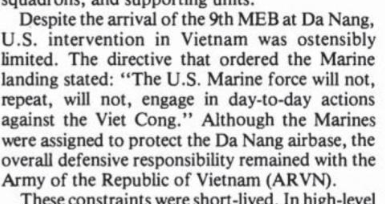
But with the troops in place, military leaders rationalized that they should be put to some good use.
General Maxwell Taylor called the defensive approach an "inglorious" plan and decided to use the troops on what he termed "search and destroy" missions in fifty-mile radii around the air base. In theory, they would rid the surrounding countryside of enemy troops and thereby further protect the air missions.
In reality, however, the missions only complicated the strategic and logistical plans of the military. More and more troops were now required – to hold the fort while the "search and destroy" teams were out in the field, to provide logistical support for those missions, to set up new enclaves that then required new defense and support, and so on. A cycle of escalation had begun without much thought behind it but a lot of disastrous consequences ahead.
U.S. Army troops followed the Marines within two months, and both expanded their missions into offensive campaigns against the Viet Cong across the South. By the end of 1965, there were nearly 200,000 US troops in Vietnam with almost 2,000 killed.
If the Trump administration puts "boots on the ground" this week, whether they admit it or not, we should all be aware of what that means, not just in terms of the immediate commitment of military force, but in terms of the likelihood that that commitment will become indefinite as well.
It's easy to put boots on the ground. It's much harder to take them back.